Singapore businesses are facing an increasingly active and opportunistic cyber threat environment. In its 13 November 2026 media statement, the Cyber Security Agency of Singapore (CSA) reported that the average monthly number of reported cyber incidents since September was three times the January–August 2026 average.
Many recent incidents involved familiar weaknesses, including exposed systems, unpatched software, weak access controls and compromised third-party suppliers. The use of artificial intelligence (AI) by threat actors could further accelerate the discovery and exploitation of vulnerabilities.
Beyond the technical impact, cybersecurity incidents can disrupt operations, delay customer commitments, expose confidential information and result in financial losses.
For organizations, the question is not simply whether cybersecurity controls are in place, but whether they are effective, consistently implemented and aligned with current business risks.
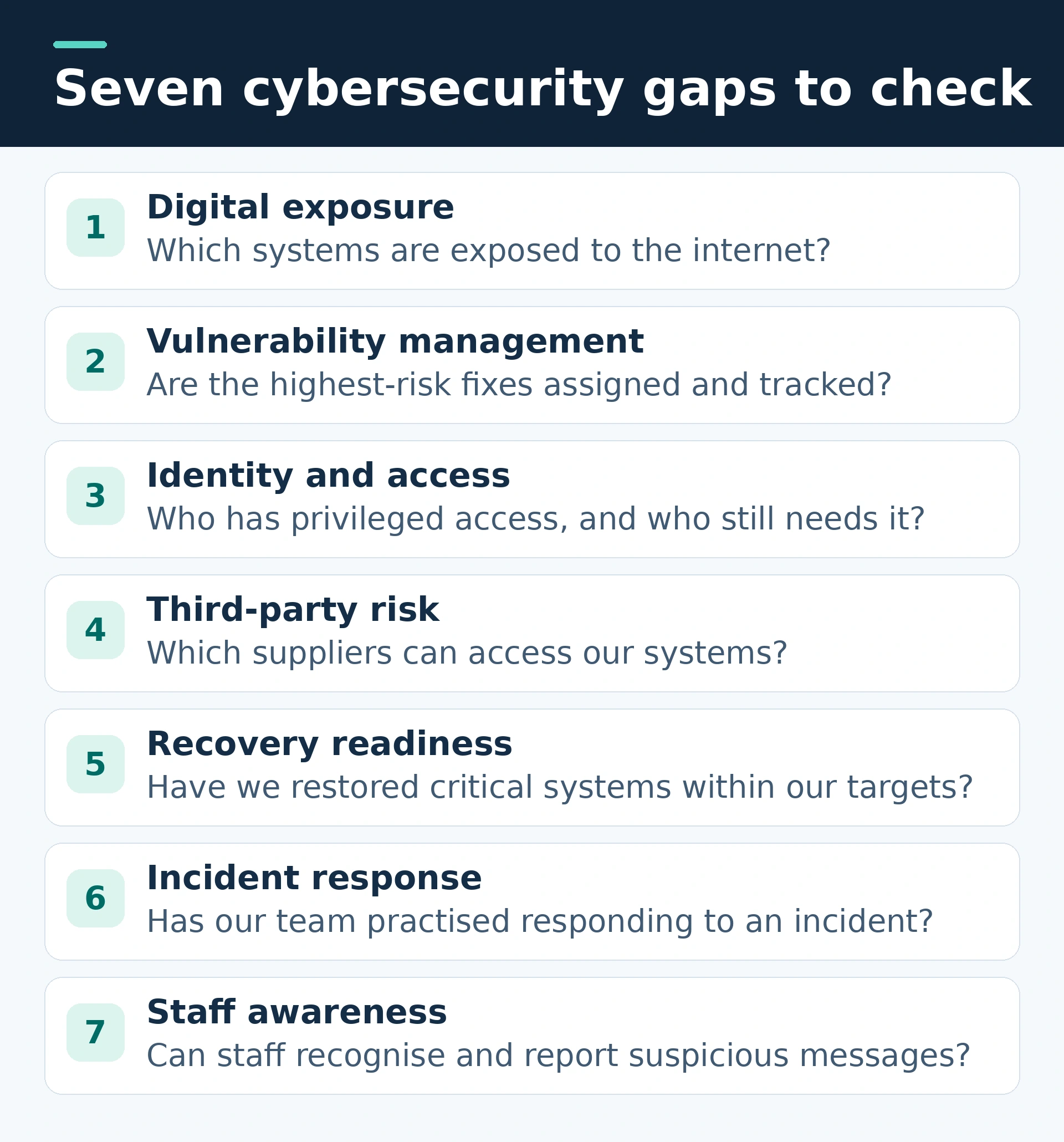
Here Are Seven Areas Worth Reviewing
1. Do You Have Full Visibility of Your Digital Exposure?
An asset inventory is an important starting point, but organizations should also understand their attack surface: the systems, applications and services through which unauthorized access could occur.
This includes internet-facing servers, application programming interfaces (APIs), cloud environments, remote access services, unsupported systems and unauthorized applications introduced without IT approval, commonly known as shadow IT.
Regular reviews can help identify unnecessary exposure, outdated systems and overlooked security responsibilities.
2. Is Vulnerability Management Driven by Risk?
Not every vulnerability presents the same level of business risk. Organizations should establish a risk-based vulnerability management process that considers severity, system exposure, known exploitation and potential operational consequences.
Remediation timelines, patching responsibilities and exceptions should be defined and monitored. Where immediate patching is not possible, alternative protective measures should be documented and reviewed.
The objective is to demonstrate that significant vulnerabilities are addressed within appropriate timeframes.
3. Are Identity and Access Controls Effectively Managed?
Effective identity management extends beyond multi-factor authentication (MFA). Organizations should review privileged accounts, service accounts, dormant accounts and excessive user permissions.
The principle of least privilege helps ensure individuals and systems receive only the access necessary for their responsibilities.
Phishing-resistant MFA, periodic access reviews and monitoring of administrative activities can further reduce unauthorized access risks.
4. Are Third-Party Cybersecurity Risks Under Control?
External service providers, software vendors and cloud platforms may introduce risks beyond an organization's direct control.
Supplier security assessments should consider contractual obligations, incident reporting arrangements, software dependencies and access to business systems. Where appropriate, third-party remote access should be restricted, time-limited and monitored.
Supplier arrangements should be reviewed as technologies and business relationships change. Outsourcing IT services does not remove an organization's responsibility for managing cybersecurity risks.
5. Can Your Business Recover Within an Acceptable Timeframe?
Regular backups alone do not establish recovery readiness. Organizations should consider offline or immutable backups to protect recovery copies against unauthorized modification or deletion.
Recovery arrangements should address two important measures:
• Recovery Time Objective (RTO): The targeted timeframe for restoring a disrupted system or operation.
• Recovery Point Objective (RPO): The targeted point in time to which information must be recovered, reflecting acceptable data loss.
Restoration testing helps determine whether recovery arrangements meet these objectives.
6. Have Your Incident Response Arrangements Been Tested?
Incident response plans should establish responsibilities for detection, classification, escalation, containment, communication and recovery.
Security monitoring and log management can support detection and investigation. Organizations should also consider applicable contractual and regulatory reporting obligations, including data breach notification requirements under Singapore's Personal Data Protection Act (PDPA).
Tabletop exercises, which simulate incident scenarios through structured discussions, help management and IT teams identify weaknesses before an actual incident occurs.
7. Is Cybersecurity Awareness Keeping Pace With Emerging Threats?
AI-assisted phishing and social engineering are making cybersecurity awareness increasingly important.
Organizations should adopt role-based training reflecting employees' responsibilities, access privileges and exposure to sensitive information. Phishing simulations, reporting exercises and periodic reviews can help evaluate training effectiveness.
Awareness programs should evolve alongside the adoption of AI tools, cloud services and digital platforms.
How Confident Are You in Your Cybersecurity Controls?
Can your organization demonstrate the following?
• Visibility of internet-facing and externally managed systems.
• Risk-based remediation of significant vulnerabilities.
• Regular reviews of privileged accounts and supplier access.
• Tested backups that meet defined recovery objectives.
• Incident response arrangements validated through exercises.
• Evidence of consistent control implementation and monitoring.
Even organizations with dedicated IT teams or existing certifications can benefit from periodic reviews as technologies, operations and customer expectations evolve.
If several of these gaps apply to your organization, a readiness and gap assessment can help you decide which to address first.
How QuESH Consultants Can Support Your Organization
Our consultancy complements existing IT and cybersecurity teams by focusing on governance, risk management, control effectiveness and management system implementation.
• Readiness and Gap Assessment. Review cybersecurity risks and IT controls, identify gaps in security, compliance and operations, and prioritize improvements based on business risk and regulatory requirements.
• Independent Second-Party and Vendor Audit. Assess how key suppliers manage cybersecurity, compliance and supply chain risks. The audit identifies weaknesses and recommends corrective actions.
• Incident and Crisis Preparedness Simulation. Use a tabletop exercise to test how management and IT teams escalate a cyber incident, make decisions and communicate. The exercise identifies gaps in the response plan.
• Business Continuity and Resilience Assessments. Review business continuity and disaster recovery plans to see whether you can maintain critical operations during a disruption and restore affected systems within your recovery targets.
Take the Next Step Towards Cybersecurity Readiness
Book a complimentary 15-minute discussion with QuESH Consultants. Tell us what prompted your review, and we’ll help you identify what to check first.
References:
• CSA — Media Statement on Recent Reported Cyber Incidents, 13 November 2026
• CSA — Advisory on Recent Uptick in Reported Cyber Incidents
• PDPC — Guide on Managing and Notifying Data Breaches Under the PDPA