Cybersecurity is no longer just a headache for your IT department. For Singapore SMEs, a single ransomware attack, data breach, or leaked customer file can instantly destroy client trust, halt daily operations, and result in massive regulatory fines.
The good news? You do not need to become a cybersecurity expert overnight. Singapore has several practical, highly recognized frameworks and certifications that show your clients, vendors, and partners that you take digital security seriously.
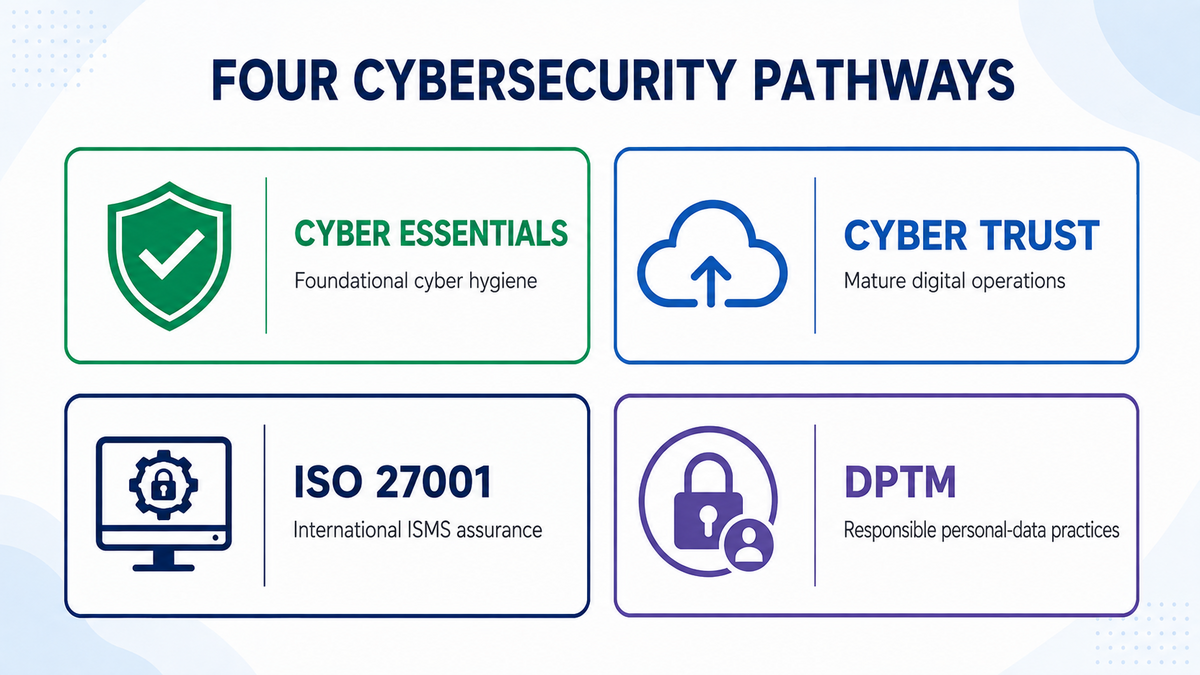
If you are looking to secure your business, you will likely come across four major options: Cyber Essentials, Cyber Trust, ISO 27001, and the Data Protection Trustmark (DPTM). Let’s break them down in plain English so you can figure out exactly what your business needs.
1. Cyber Essentials: Building Your Digital Foundation
Think of the Cyber Essentials Mark as your business's basic cyber hygiene checklist. Administered by the Cyber Security Agency of Singapore (CSA), this certification is designed specifically for SMEs that want to implement fundamental security measures without getting overwhelmed.
To pass, your SME will look at the basics:
• Securely managing user accounts and access controls (no shared passwords!).
• Protecting your office devices and networks with proper firewalls.
• Keeping all business software updated and patched.
• Having a simple plan to respond if a common cyber threat occurs.
The Verdict: This is the perfect, cost-effective starting point for smaller SMEs that want to prove to local clients that they have their basic defenses up.
2. Cyber Trust: For Scaling and Mature Digital Operations
Also administered by the CSA, the Cyber Trust Mark is the next step up. It is meant for organizations with larger digital footprints that rely heavily on cloud platforms, or that handle more complex digital operations.
As your business grows, your risks evolve. Cyber Trust helps you take a highly structured approach to cyber risk management. Depending on how you operate, this framework deepens your security in areas like:
• Advanced cloud security and encryption.
• Operational technology (OT) security for machinery or logistics systems.
• Formalized cybersecurity governance and executive-level risk tracking.
The Verdict: If your SME is angling to work with multinational corporations (MNCs) or operates in high-risk sectors like fintech or healthcare, the Cyber Trust Mark shows you are playing at a mature level.
3. ISO 27001: The International Gold Standard
ISO/IEC 27001 is the globally recognized heavy hitter for establishing an Information Security Management System (ISMS).
This framework goes way beyond simply installing a great antivirus tool or changing your passwords. It forces your organization to look at information security holistically across three core pillars: People, Processes, and Technology.
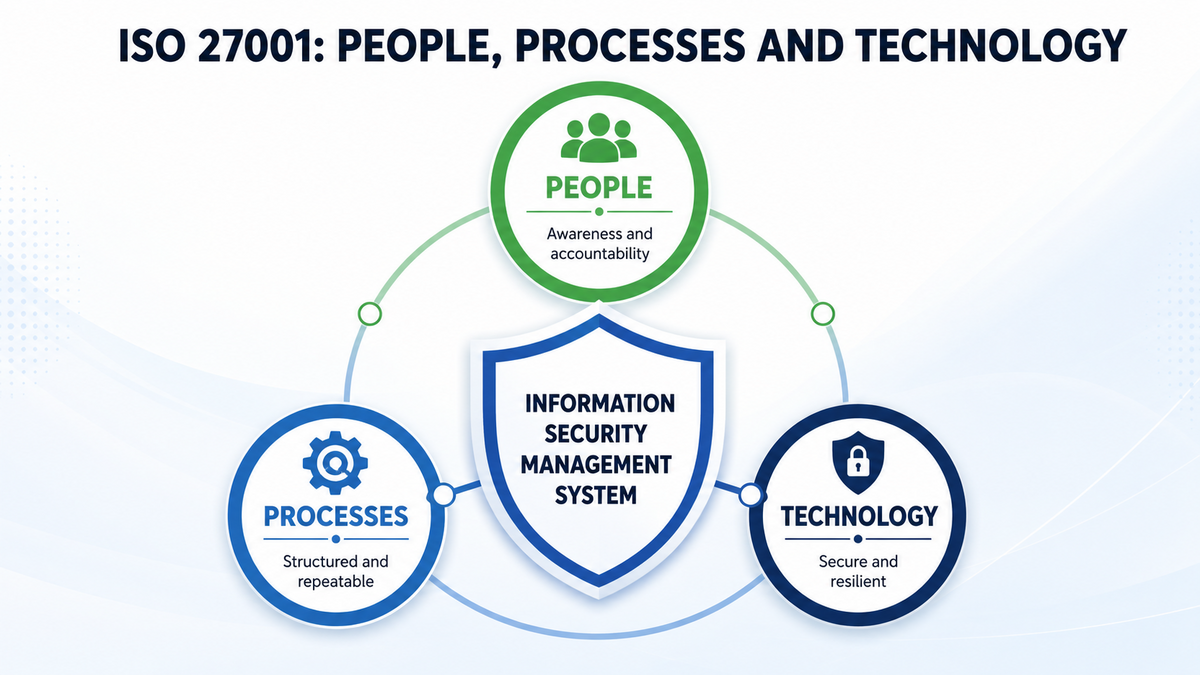
Achieving ISO 27001 certification proves that your company has a continuous, rock-solid system to identify security risks, protect proprietary data, and constantly improve its defenses.
The Verdict: If your SME handles highly sensitive intellectual property, operates within global supply chains, or plans to expand overseas into markets like Europe or the US, ISO 27001 is the ultimate trust badge.
4. Data Protection Trustmark (DPTM): Safeguarding Personal Data
Cybersecurity and data protection are close cousins, but they are not the same thing. While cybersecurity protects your networks from hackers, data protection is all about how your business legally and responsibly collects, uses, stores, and disposes of personal data.
Administered by the Infocomm Media Development Authority (IMDA), the Data Protection Trustmark (DPTM) is a voluntary enterprise-wide certification. It tells the world that you are aligned with Singapore’s strict Personal Data Protection Act (PDPA) guidelines.
The Verdict: If your SME runs an e-commerce platform, handles B2C consumer data, manages large HR databases, or deals with massive amounts of personal information daily, DPTM protects you from devastating PDPA leaks and public reputational damage.
Related article: DPTM to SS 714
Which Badge Belongs on Your Website?
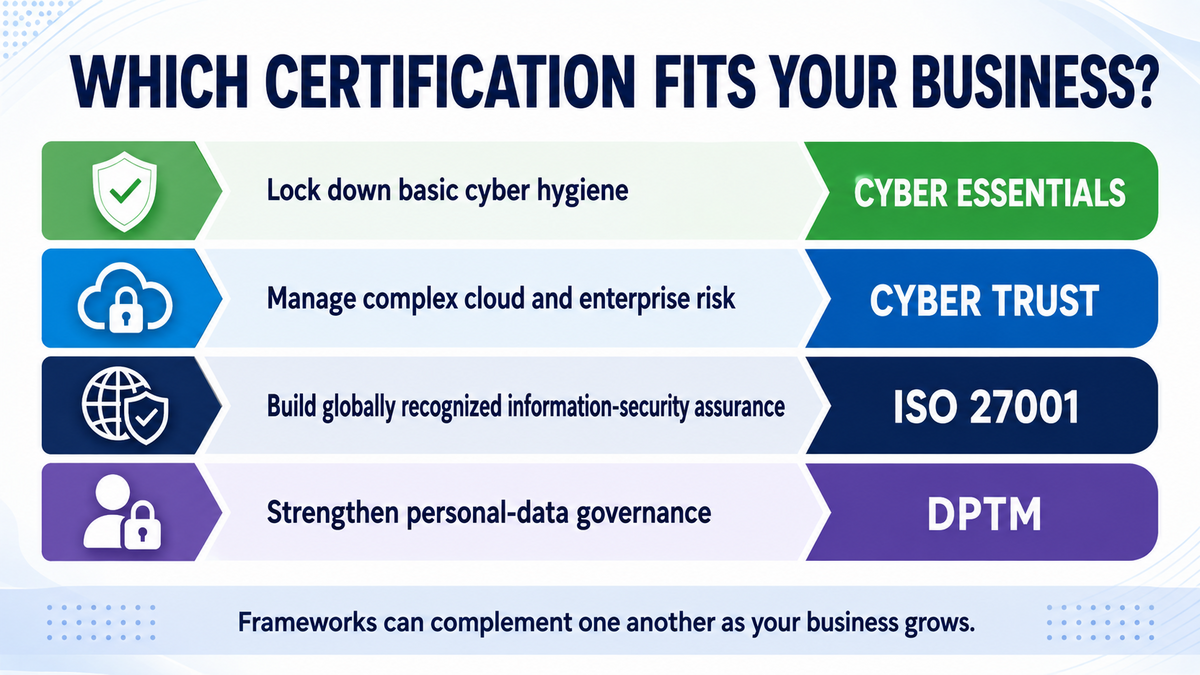
You do not have to choose just one; these certifications often complement each other. The right fit depends entirely on your current size, industry, and who your clients are.
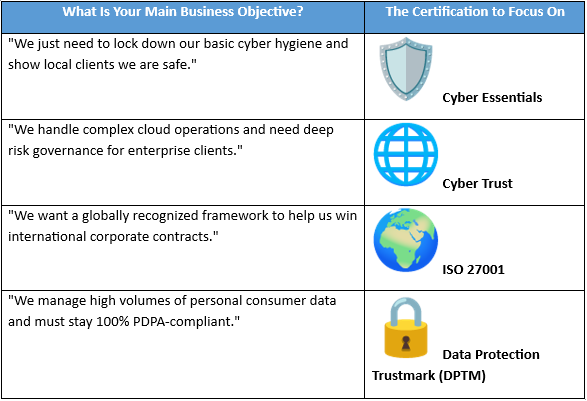
Counting the Cost (and Tapping on Grants)
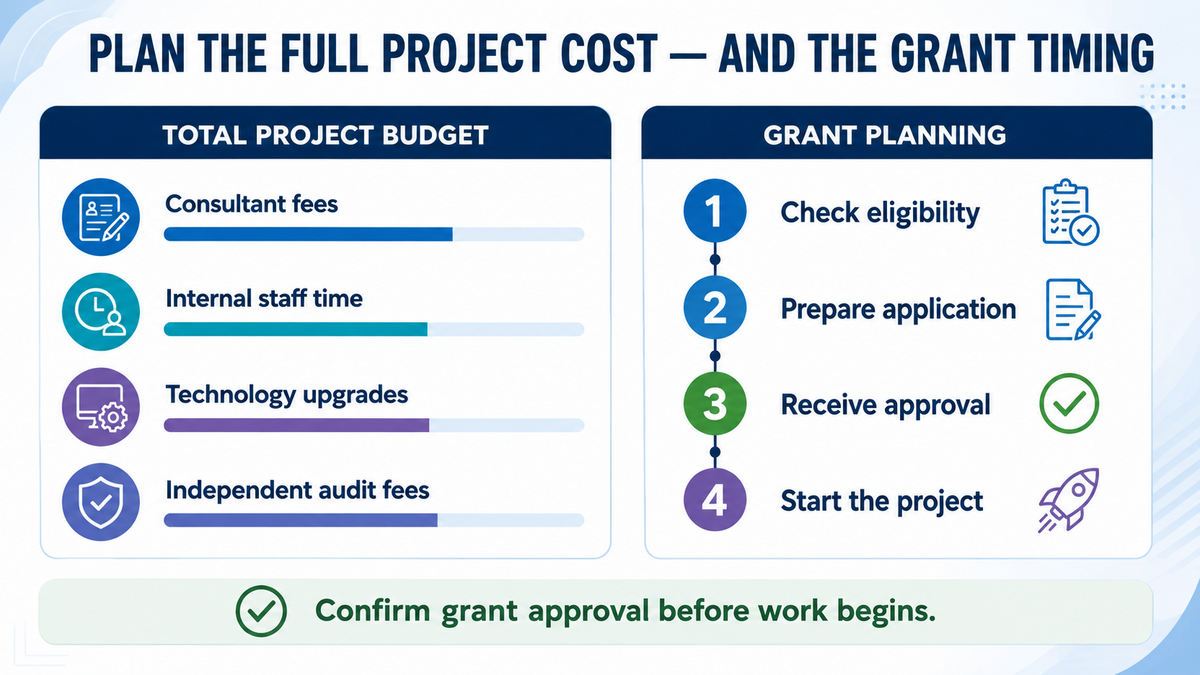
What does it cost to get secure? There is no flat rate. Your total investment depends on your employee count, the complexity of your current IT setup, and which badge you are aiming for. Your budget will generally split into consultant fees, internal staff hours, software upgrades, and official audit fees.
The good news for Singapore SMEs is that you do not have to shoulder the burden alone. The Singapore government aggressively supports local businesses upgrading their digital security.
Depending on your eligibility, your project might qualify for funding support through the Enterprise Singapore Enterprise Development Grant (EDG) or specialized IMDA capability schemes. These grants can significantly offset consultancy and solution costs—but remember, you must get grant approval before kicking off your project.
Stop Treating Security Like an Expense. It’s Your Best Sales Tool

At the end of the day, getting certified isn't about checking a compliance box to keep hackers away. It is a strategic sales tool. When you bid for government tenders or pitch to large enterprise clients, having these certifications attached to your proposal instantly moves you higher over the rest of the pile. It tells your clients: "Your data is completely safe with us."
Let’s Clear the Confusion and Protect Your Business
Trying to read through hundreds of pages of CSA and IMDA documentation while running a business is exhausting. If your SME doesn't have a dedicated in-house compliance officer or CISO, you shouldn't have to guess your way through the requirements.
That is where we come in.
We have successfully guided more than 50 companies across Singapore through their compliance journeys, helping them secure their ISO 27001, Cyber Essentials, Cyber Trust, and DPTM certifications smoothly and efficiently.
We don't do boilerplate, overcomplicated frameworks that slow your team down. We design practical, lightweight security policies built around how your business actually operates. From your initial gap analysis and grant application navigation to training your staff and sitting with you during the final official audit, we manage the heavy lifting.
Not sure which certification your clients are looking for?
Contact our team today for a quick, zero-obligation discovery call. Let's figure out the most practical, cost-effective path to lock down your business and win bigger contracts!