Singapore employers should review heat-stress arrangements before 1 December 2026. The Ministry of Manpower (MOM) has enhanced the Heat Stress Management Framework by making four previously recommended practices mandatory.
They supplement existing risk assessment, acclimatisation, WBGT monitoring, hydration, rest, emergency response and vulnerable-worker requirements. Readiness requires clear responsibilities, trained supervisors and controls implemented at the workplace each day.
What Becomes Mandatory?
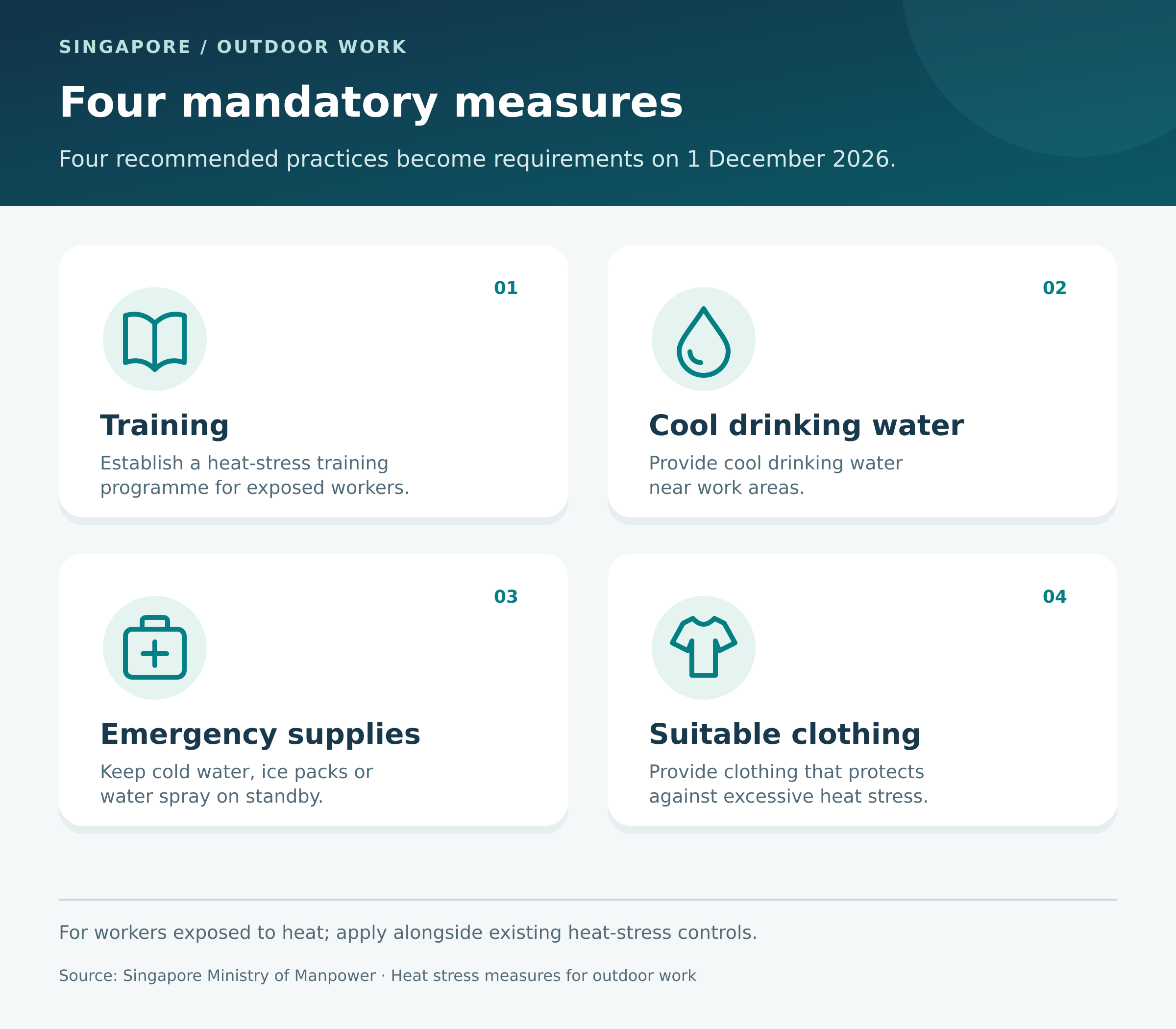
From 1 December 2026, employers must:
• Establish a heat-stress training programme for workers exposed to heat.
• Provide cool drinking water near work areas.
• Keep cold water, ice packs or water spray available for emergency response.
• Provide suitable clothing that protects workers from excessive heat stress.
MOM also recommends shaded rest areas that are well ventilated, insulated or cooled.
Heat stress occurs when the body cannot cool sufficiently. Symptoms include weakness, dizziness, intense thirst, nausea, headaches, muscle cramps and breathlessness. It can progress to fatal heat stroke. Heat exposure may also impair concentration during hazardous work.
Which Sectors Are Most Affected?
The framework is based on actual exposure, not business classification. Outdoor work means work performed primarily in the open without permanent shade. Any employer or occupier with these activities should assess whether the requirements apply.
Priority sectors include:
• Construction, civil engineering and specialist contracting
• Shipyards, marine and offshore operations
• Oil and gas, petrochemical, chemical and process industries
• Ports, logistics, land transport and airport ground operations
• Utilities, telecommunications and field engineering
• Waste collection, outdoor cleaning and pest control
• Landscaping, arboriculture and agriculture
• Property maintenance, facilities management, security and outdoor events
Construction sites with contract sums of S$5 million or more, shipyards and the process industry must use on-site WBGT meters. Other workplaces may refer to relevant WBGT readings through the National Environment Agency’s myENV application.
Indoor risks can also arise in foundries, kitchens, laundries, boiler rooms, food manufacturing, welding and furnace operations. These workplaces should follow broader WSH heat-stress guidance.
What Should Employers Do Now?
First, identify every routine, non-routine and contractor activity involving outdoor work or significant heat. Consider workload, duration, radiant heat, protective clothing, working hours and access to water and rest facilities.
Update relevant risk assessments and safe-work procedures. A general reference to hot weather is insufficient; controls should match the task, location and workers involved.
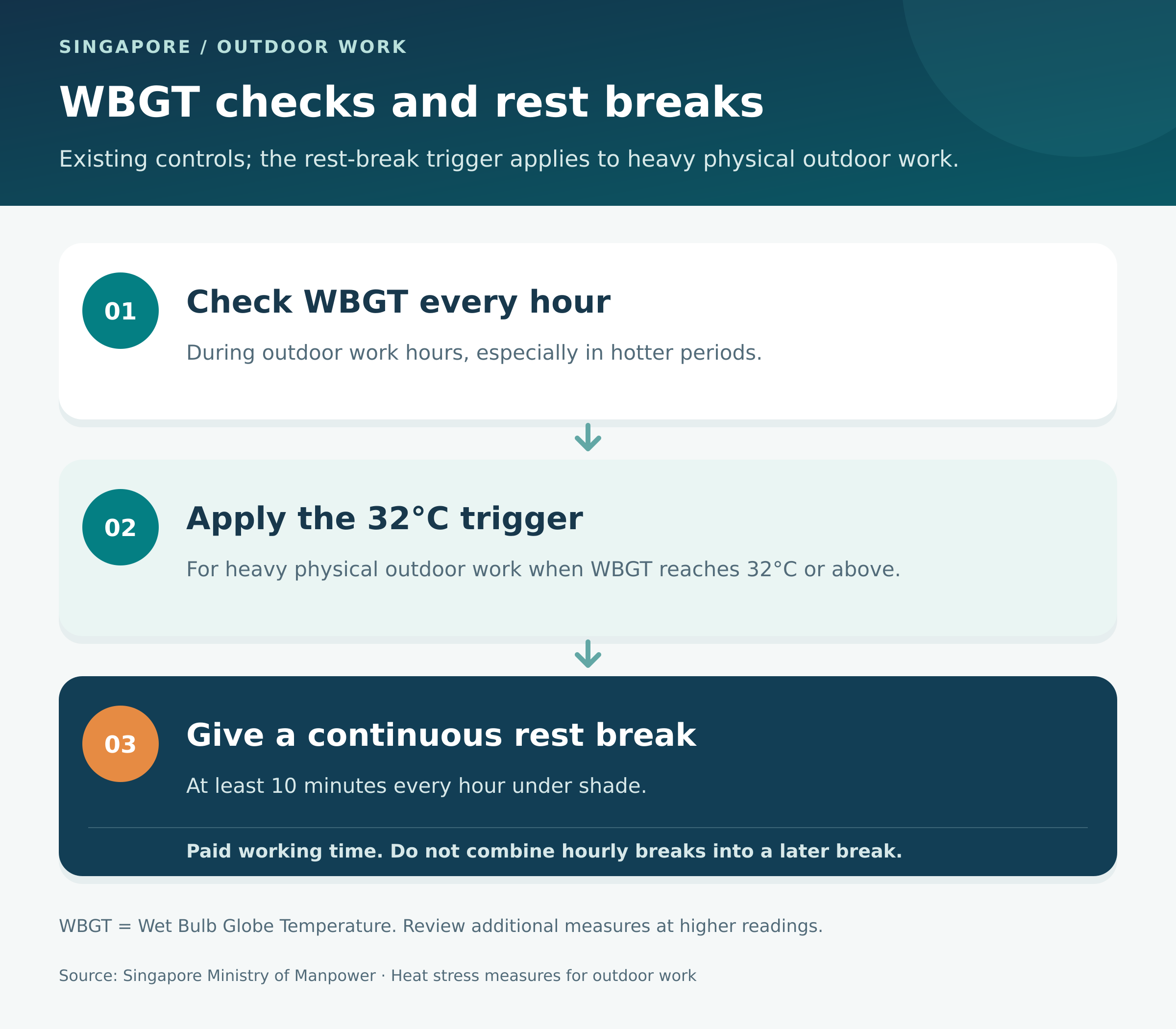
Assign responsibility for checking WBGT every hour during outdoor work, recording results and communicating the required response. For heavy physical outdoor work, workers must receive a continuous rest break of at least 10 minutes every hour when WBGT reaches 32°C or above. These breaks are paid working time and cannot be combined into one later break.
Employers should establish acclimatisation arrangements for workers newly assigned to outdoor work or returning after more than one week away. Their exposure should increase gradually over at least seven days. Supervisors should also identify workers who may require closer monitoring or temporary redeployment.
Training should help workers and supervisors recognise heat illness, follow hydration and rest arrangements, use the buddy system, report symptoms and respond during an emergency. Instructions should be understandable and supported by multilingual materials where necessary.
Emergency procedures should identify first aiders, cooling supplies, communication arrangements and access to medical assistance. If a worker becomes drowsy or unconscious, call 995 immediately. Emergency supplies must be accessible, maintained and known to supervisors.
Integrating Readiness with ISO 45001 and bizSAFE
Organizations with ISO 45001 or bizSAFE systems can integrate these measures into existing processes for hazard identification, legal compliance, operational control, competence, contractor management, emergency preparedness, monitoring and internal audits.
However, certification or bizSAFE status alone does not demonstrate compliance. Organizations must show that heat-stress controls are suitable, communicated and consistently applied on site.
QuESH Consultants can support organisations in reviewing their workplace safety and health risk management arrangements, strengthening risk assessments and procedures, and integrating new requirements into existing WSH practices.
Use the period before 1 December 2026 to confirm that written procedures reflect actual workplace practices.
Speak with QuESH Consultants about practical support to strengthen your workplace safety and health practices across worksites, projects and day-to-day operations.