For an HR consultancy, quality is not an abstract idea. It is whether client requirements are understood correctly, candidates are assessed consistently, payroll changes are processed accurately, deadlines are met, and service issues are resolved before they affect trust.
ISO 9001 gives Singapore HR service providers a structured way to manage these responsibilities. It can help an organization turn individual experience and informal practices into reliable, measurable processes that continue to work as the business gains clients, employees and service lines.
The Short Answer: Why Is ISO 9001 Relevant to HR Service Providers?
ISO 9001 is relevant because HR consultancies sell dependable service delivery as much as professional expertise.
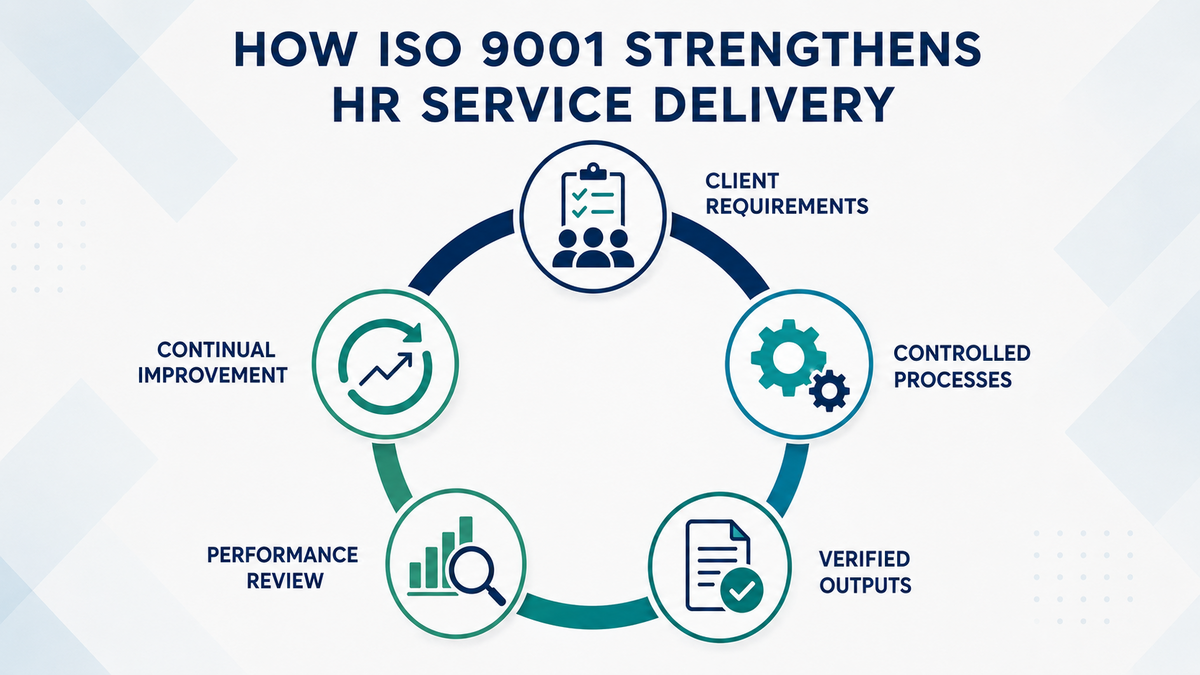
A strong quality management system, or QMS, helps the organization:
- define what has been promised to each client;
- control how services are planned and delivered;
- verify important outputs before they are released;
- maintain competent and appropriately trained personnel;
- monitor client satisfaction, complaints, errors and delays;
- investigate problems and prevent them from recurring; and
- continually improve the way the business operates.
Certification is voluntary unless a customer, contract or tender specifically requires it. It does not guarantee a contract award, but it can provide independent evidence that the organization has established and maintained a controlled quality management system. ISO notes that certification is commonly considered in supplier approvals, government tenders and international partnerships.
Who This Guide Is For
This guide is written for HR consultancies and related service providers in Singapore, including recruitment firms, payroll providers and HR outsourcing organizations.
These businesses do not all deliver the same services or face the same risks. Each organization should therefore define its quality management system around the activities, locations, responsibilities and client commitments it actually controls.
Where ISO 9001 Fits into an HR Services Business
ISO 9001 does not prescribe one fixed way to run an HR consultancy. It requires the organization to understand its context, customer and applicable requirements, then establish controls appropriate to its services and risks.
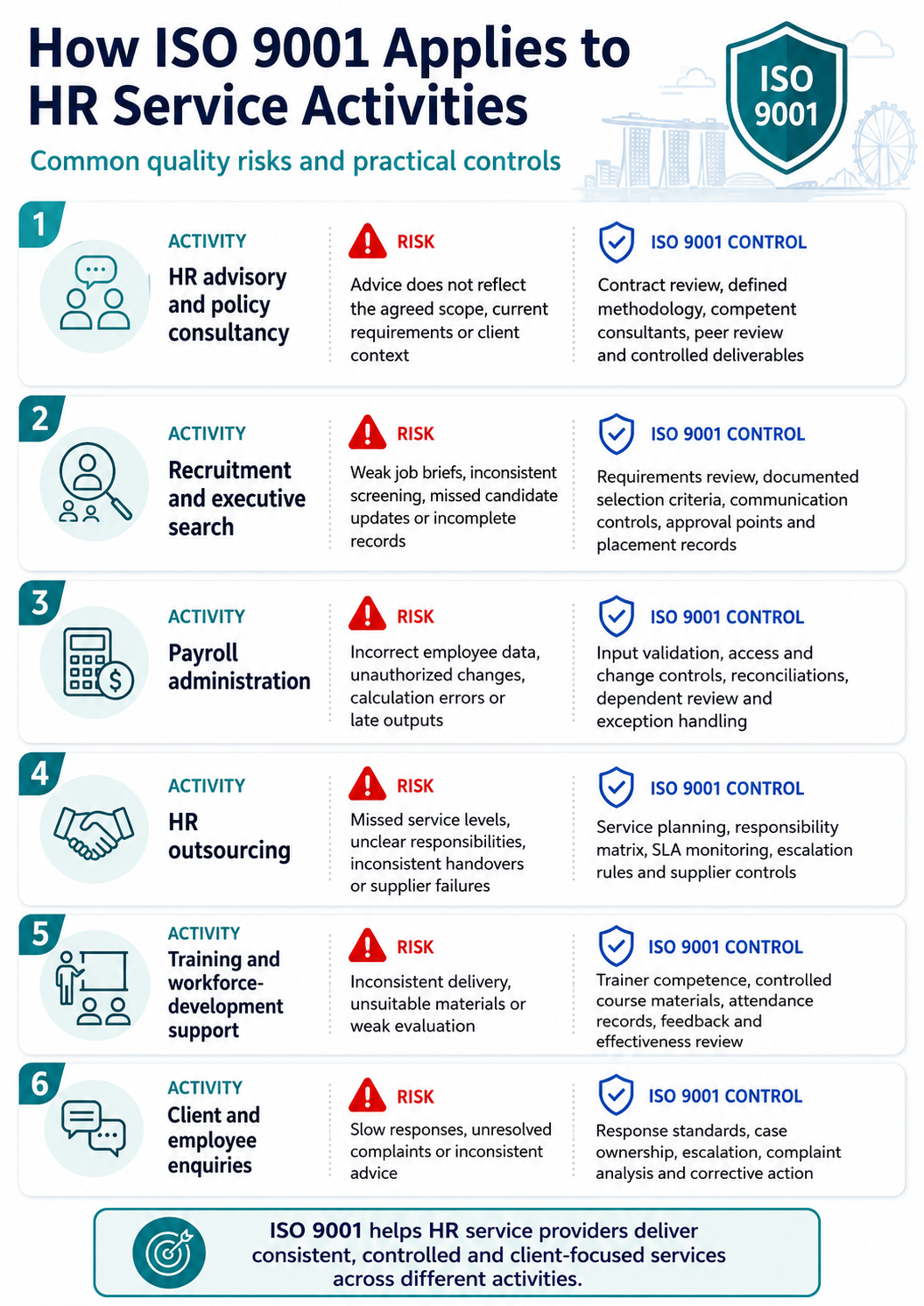
The objective is not to create paperwork for every activity. The objective is to make important work repeatable, traceable and less dependent on one person's memory.
Why HR Service Quality Becomes Harder as the Business Grows
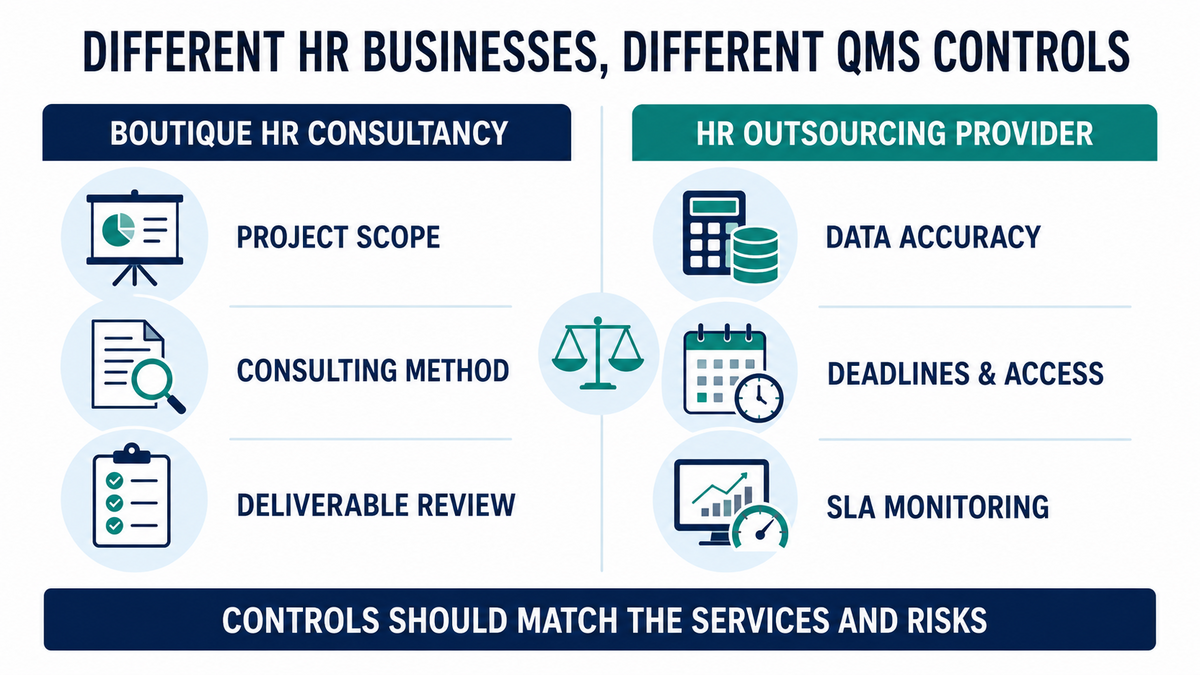
A small HR advisory firm may initially operate through direct communication between the owner, consultants, and clients. That can work when the team and client base are small. As the company grows, however, information is passed between more people, systems, and external providers.
A larger or more complex HR organization may manage:
• multiple client contracts and service-level agreements;
• candidate, employee and payroll information;
• different screening or approval requirements for each client;
• monthly payroll deadlines and statutory inputs;
• work performed by remote teams or subcontractors;
• client-specific templates, policies and reporting formats; and
• complaints, corrections, replacements and service recovery.
Without defined controls, the same request can be handled differently by different employees. A quality management system creates agreed methods, responsibilities, review points and records without removing the professional judgment that HR work requires.
Two Different HR Businesses, Two Different ISO 9001 Systems
Consider two Singapore service providers.
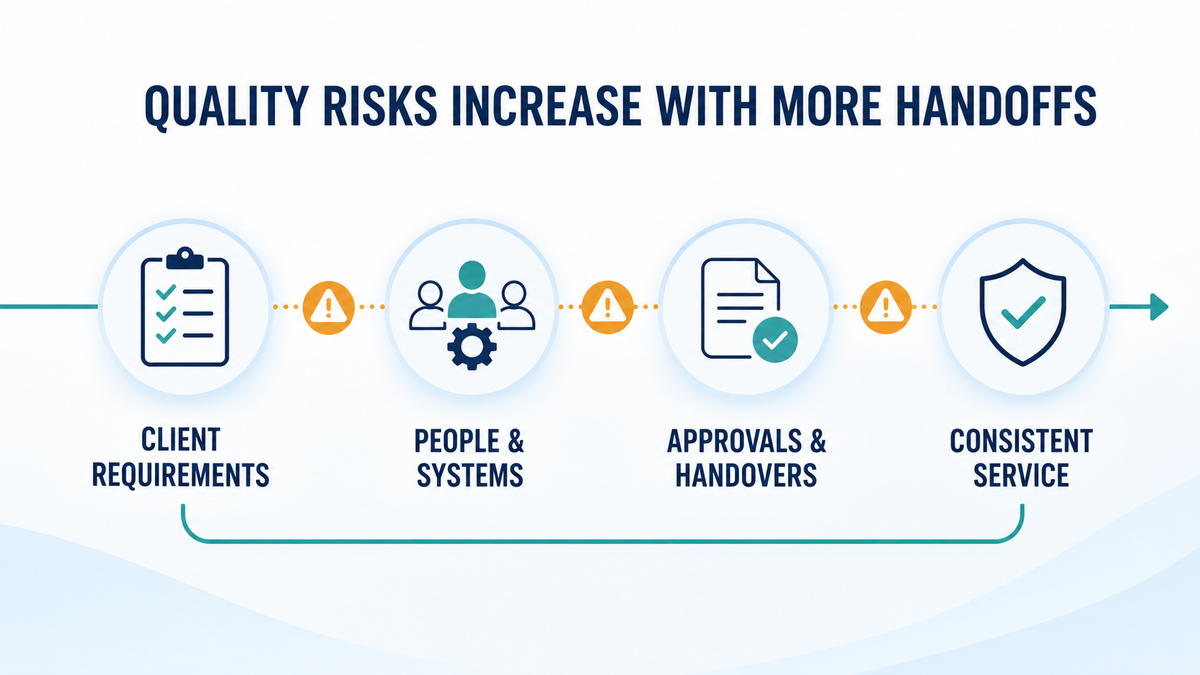
The first is a boutique HR consultancy with six employees. It focuses on organizational design, performance management frameworks, and HR policy development. Its main quality risks are unclear project scope, inconsistent consulting methods, version-control mistakes, and recommendations that are not sufficiently tailored to the client.
The second is an HR outsourcing organization managing recruitment coordination, employee records and payroll inputs for multiple clients. Its risks include data errors, missed cut-off dates, unauthorized changes, incomplete handovers and failures to meet contractual service levels.
Both organizations can implement ISO 9001, but their systems should not be identical. The boutique consultancy may need stronger project and deliverable-review controls. The outsourcing provider may require more detailed transaction controls, reconciliations, access management, escalation procedures and performance monitoring.
The certification scope should clearly describe the services, locations and activities covered. It should not claim activities the organization does not control or deliver.
Singapore Compliance Still Matters
ISO 9001 is a management-system standard. It does not replace legal, licensing, contractual or professional obligations.
For example:
• Organizations that place jobseekers with employers generally require an employment agency licence from Singapore's Ministry of Manpower, unless an exemption applies.
• Organizations handling candidate, employee and client personal data must assess and meet their obligations under Singapore's Personal Data Protection Act.
• Payroll-related services should be designed around applicable client obligations, including itemized payslips, employment records, salary requirements and CPF submission timelines.
• Each provider must also identify the contractual, sector-specific and client requirements applicable to its actual scope of work.
ISO 9001 helps the organization establish a systematic way to identify applicable requirements, translate them into operational controls, verify that those controls are working, and act when something goes wrong. Certification itself is not proof that every legal requirement has been met.
Starting from Scratch Versus Improving Existing Practices
Most established HR firms are not starting from zero. They may already have proposal templates, client onboarding checklists, candidate-tracking systems, payroll workflows, approval matrices, service-level reports and complaint-handling practices.
The first step should therefore be a gap assessment, not an immediate rewrite of every document.
A practical gap assessment asks:
1. Which existing processes already work well?
2. Where are responsibilities unclear?
3. Which errors, delays or complaints recur?
4. Are client requirements reviewed before work begins?
5. Are important outputs checked before release?
6. Are process results measured and discussed by management?
7. Can the organization demonstrate corrective action and continual improvement?
The QMS should build on effective practices and close genuine gaps. It should not create a second system that employees follow only when an audit is approaching.
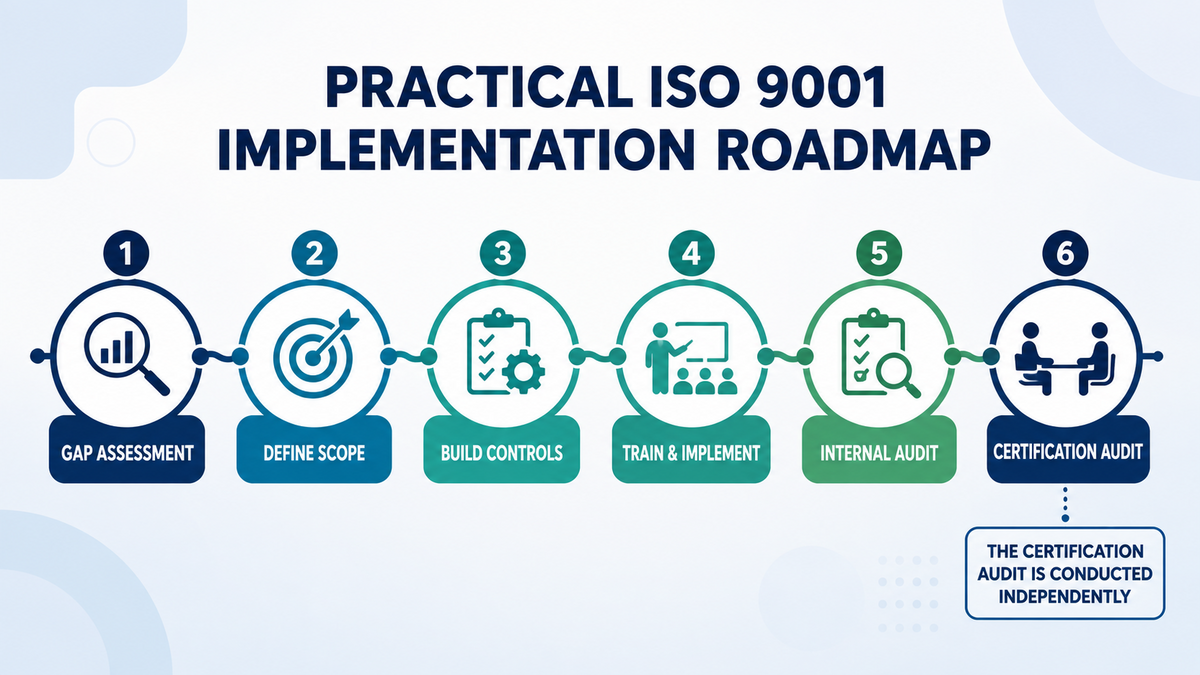
Coming in next Article
Once the gaps are clear, the next step is turning them into a practical implementation plan. In Part II article, we examine what Singapore HR service providers should expect when implementing ISO 9001 — including the upcoming standard revision, implementation timeline, indicative consultancy costs, practical controls, and certification preparation.
Continue to Part II:
Like what you read?
Subscribe with Us!