What Is Happening with the ISO 9001 Revision?
At the time of publication, ISO 9001:2015 remains the current certifiable edition. On 7 August 2026, the ISO 9001 Final Draft International Standard was confirmed as approved. The sixth edition is scheduled for publication on 16 September 2026.
Organizations beginning implementation now should not stop their improvement work. The core disciplines—understanding requirements, controlling processes, measuring performance, addressing risk and improving results—remain valuable. However, they should coordinate with their consultant and accredited certification body so that the implementation and certification plan reflects the final published edition and formal transition arrangements when these become available.
Existing ISO 9001:2015-certified organizations should continue maintaining their current QMS and wait for confirmed transition requirements rather than relying on draft commentary or unverified deadlines.
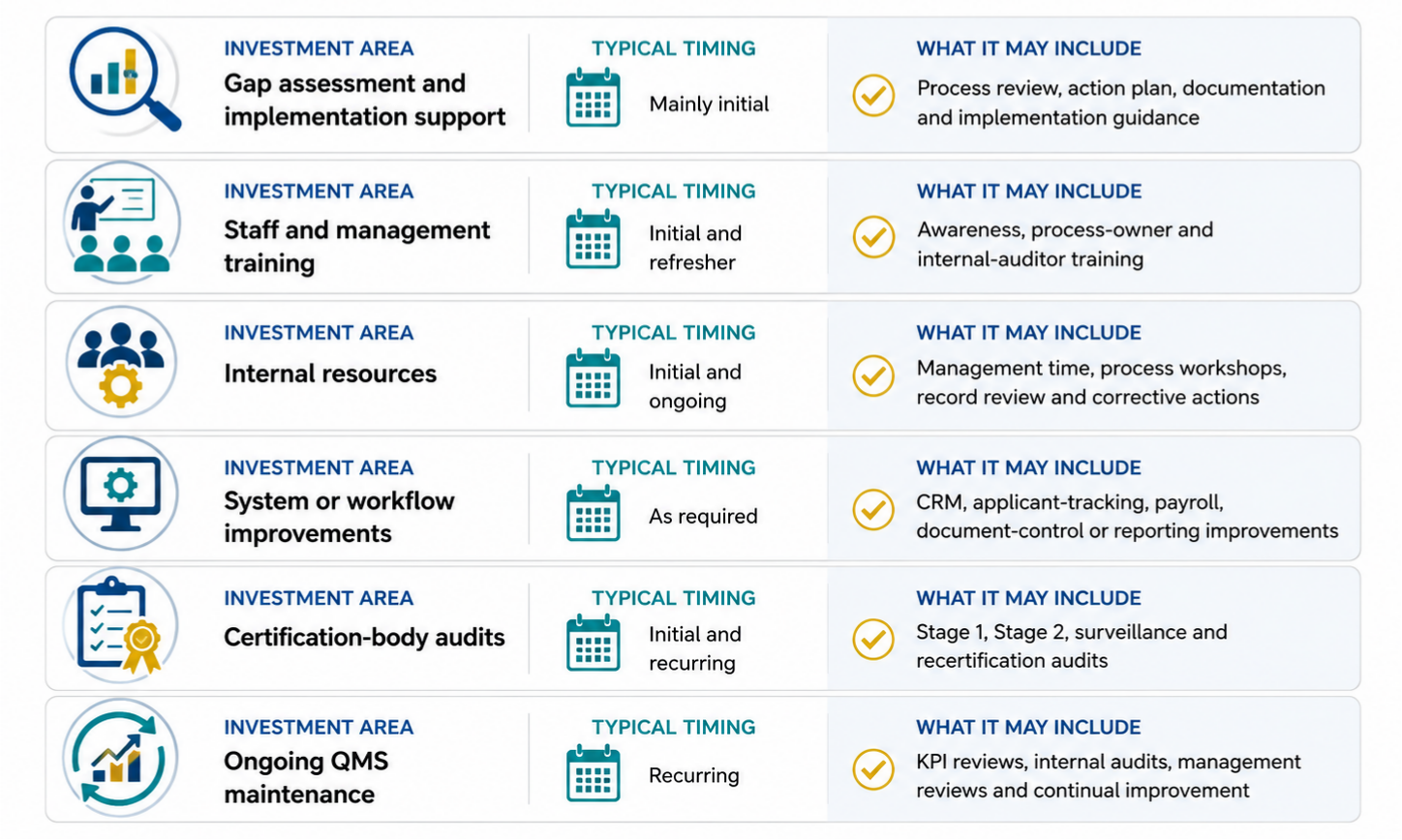
What Should an HR Firm Budget and Resource For?
The investment depends on the number of employees and locations, service complexity,
certification scope, existing controls, outsourced processes and the level of implementation support required.
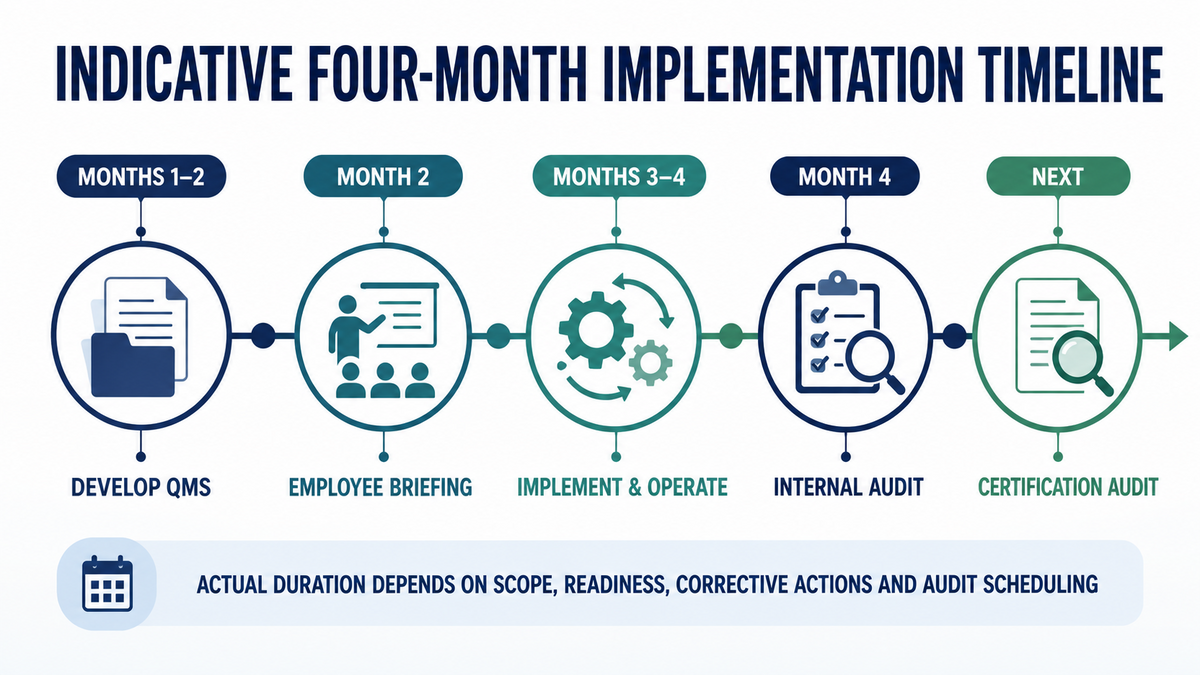
Indicative timeline: For a relatively straightforward HR consultancy with one location, available process owners and some existing procedures, implementation may take approximately four (4) months.
The organization may then be ready to proceed to the certification audit. However, this does not guarantee that the ISO 9001 certificate will be issued within four months. The overall timeline may be affected by the certification scope, number of locations, process maturity, management availability, corrective actions and the certification body’s audit schedule.
Indicative consultancy cost: For a relatively straightforward, single-site HR consultancy, consultancy support for a four-month ISO 9001 implementation programme may range from approximately S$6,000 to S$8,000. This may cover a gap assessment, QMS documentation, employee briefing, implementation guidance, and an internal audit. It is an indicative planning range, not a fixed quotation or market-wide average.
Before approving a proposal, ask what is included, what is excluded, which locations and services are covered, what timeline is expected, and what recurring surveillance costs will apply.
Smart Ways to Implement ISO 9001 Without Overcomplicating the Business
1. Start with service failures and client expectations
Review recurring complaints, payroll corrections, replacement cases, missed deadlines, handover problems, and client feedback. This shows where stronger controls will create real value.
2. Use the systems employees already work with
An applicant-tracking system, payroll platform, CRM, or project-management tool can hold controlled workflows and records. Avoid duplicating the same information in separate ISO files unless there is a clear reason.
3. Assign genuine process owners
The people who manage recruitment, consulting projects, payroll, or client services should own the relevant processes. The QMS should not sit entirely with one compliance employee.
4. Measure a focused set of useful indicators
Possible measures include:
• client satisfaction;
• response and turnaround times;
• payroll accuracy and correction rates;
• placement or replacement outcomes;
• complaint closure time;
• service-level achievement;
• overdue corrective actions; and
• repeat business or client retention.
Use only indicators that support decisions. A large dashboard that nobody reviews will not improve quality.
5. Integrate related controls where appropriate
Organizations processing large volumes of sensitive information may also consider ISO/IEC 27001 for information security. Providers responsible for time-critical payroll or outsourced HR operations may benefit from business-continuity controls aligned with ISO 22301. These standards address different risks and should be considered based on business and client needs, not added automatically.
Is ISO 9001 Worth It for a Singapore HR Consultancy?
ISO 9001 is most valuable when it is used to improve the business rather than treated as a
certificate-display exercise.
A well-implemented QMS can help an HR service provider:
• reduce avoidable errors and rework;
• provide more consistent client experiences;
• onboard employees and contractors more effectively;
• retain operational knowledge when key personnel leave;
• respond to complaints with evidence and clear ownership;
• demonstrate service controls during supplier assessments;
• support tender or vendor-registration requirements where certification is requested; and
• scale services without losing control of quality.
Certification does not guarantee regulatory compliance, tender eligibility, customer satisfaction, or commercial success. Its value depends on whether management uses the system to make decisions and improve performance.
Frequently Asked Questions
Is ISO 9001 mandatory for HR consultancies in Singapore?
No. ISO 9001 certification is generally voluntary unless required by a client, contract, tender or other applicable obligation.
Can ISO 9001 cover recruitment, payroll and HR outsourcing?
Yes, if those services are within the organization's operations and certification scope. The controls and audit evidence must reflect the services actually delivered.
Does ISO 9001 replace an MOM employment agency licence or PDPA compliance?
No. ISO 9001 does not replace licensing or legal obligations. It can help organize the processes used to identify, implement and monitor applicable requirements.
Can a small HR consultancy become ISO 9001 certified?
Yes. ISO 9001 can be applied to organizations of any size. The QMS should be proportionate to the firm's services, structure and risks.
Should an organization wait for the next ISO 9001 edition?
Organizations can begin improving their processes now. They should confirm the certification approach and applicable edition with their consultant and certification body once the revised standard and transition arrangements are officially available.
How long does implementation take?
Start with an ISO 9001 Readiness Review
An HR consultancy does not need a heavy system. It needs a system that makes client requirements clear, important work consistent, results measurable and problems less likely to recur.
QuESH Consultants can conduct an ISO 9001 readiness review for HR consultancy, recruitment, payroll, and HR outsourcing operations. The review can help identify existing strengths, priority gaps, relevant process controls and a practical route toward implementation and certification readiness.
Request a 15-minute introductory discussion with QuESH.
Share your main services, team size, number of locations, and current management system status so that the discussion can focus on your actual business requirements.