If your team changes its picking process after a series of incorrect orders, how will you know whether the change worked? ISO 9001:2026 asks organisations to plan that follow-up when they change their quality management system (QMS).
Published on 16 September 2026, the revised standard also places greater emphasis on leadership, quality culture, ethical behaviour, and the separate management of risks and opportunities.
First Certification or Transition
If you are seeking ISO 9001 certification for the first time, define the sites, activities, products and services covered by your QMS. Identify customer and applicable legal requirements, set quality objectives, and assign process owners.
Check that your controls for delivery, suppliers, staff competence and complaints meet the requirements of the 2026 edition.
If you are transitioning from ISO 9001:2015, compare the revised requirements with how your organisation currently works. For every gap, record who will close it, when it is due, and what evidence will show that the action has been effective.
The expanded Annex A can help you interpret the requirements and apply them consistently.
Global Accreditation Cooperation Incorporated (Global ACI) has set the following transition dates for accredited certification:
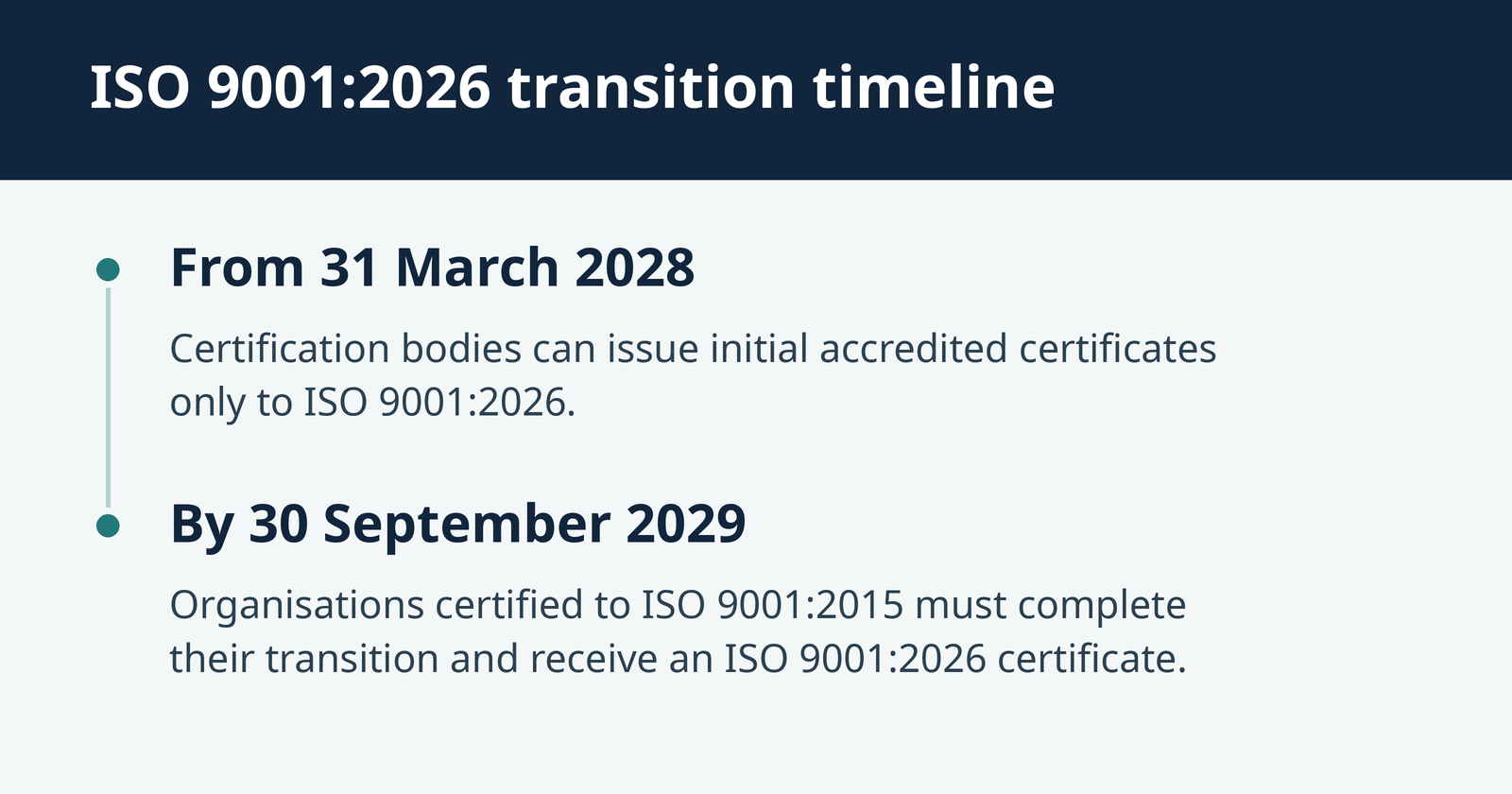
Ask your certification body when it can issue accredited certificates to the 2026 edition. If you already hold a certificate, plan around its expiry date and scheduled audits.
Business Context and Leadership
Determine whether climate change is relevant to your QMS (4.1) and consider climate-related requirements from customers and other interested parties (4.2).
For example, a cold-chain operator may need to consider whether prolonged heat could affect agreed storage temperatures. These climate-related considerations carry forward from the 2024 amendment to ISO 9001:2026.
Leaders are now expected to promote a quality culture and ethical behaviour. Employees should understand what this means in their day-to-day work.
A dispatch briefing may explain when staff should raise an error, while an issue log can show how a supervisor followed up. These records can demonstrate that quality culture is being actively supported rather than treated as a policy statement (5.1 and 7.3).
Check that your quality policy reflects how your organisation operates and where it is heading. The revised clause is now titled Quality Policy (5.2), strengthening its link to organisational context, strategy, values and integrity.
Use role descriptions to show who reports QMS performance and who is responsible for identifying opportunities for improvement (5.3). ISO 9001:2026 separates these responsibilities more clearly.

Tools, Knowledge and Work Environment
Give staff the tools, information and access they need to perform their work effectively—whether on site, remotely, or in a combined arrangement (7.1).
Quality culture and ethical behaviour can also influence the environment in which work is carried out. For example, employees should feel able to raise quality concerns without fear of blame.
Retain, apply and share the organizational knowledge your QMS depends on. A handover guide, lessons-learned record or knowledge repository can help a trained colleague step into a role with minimal disruption.
Planning for Risks and Opportunities
ISO 9001:2026 gives clearer separation between managing risks and pursuing opportunities.
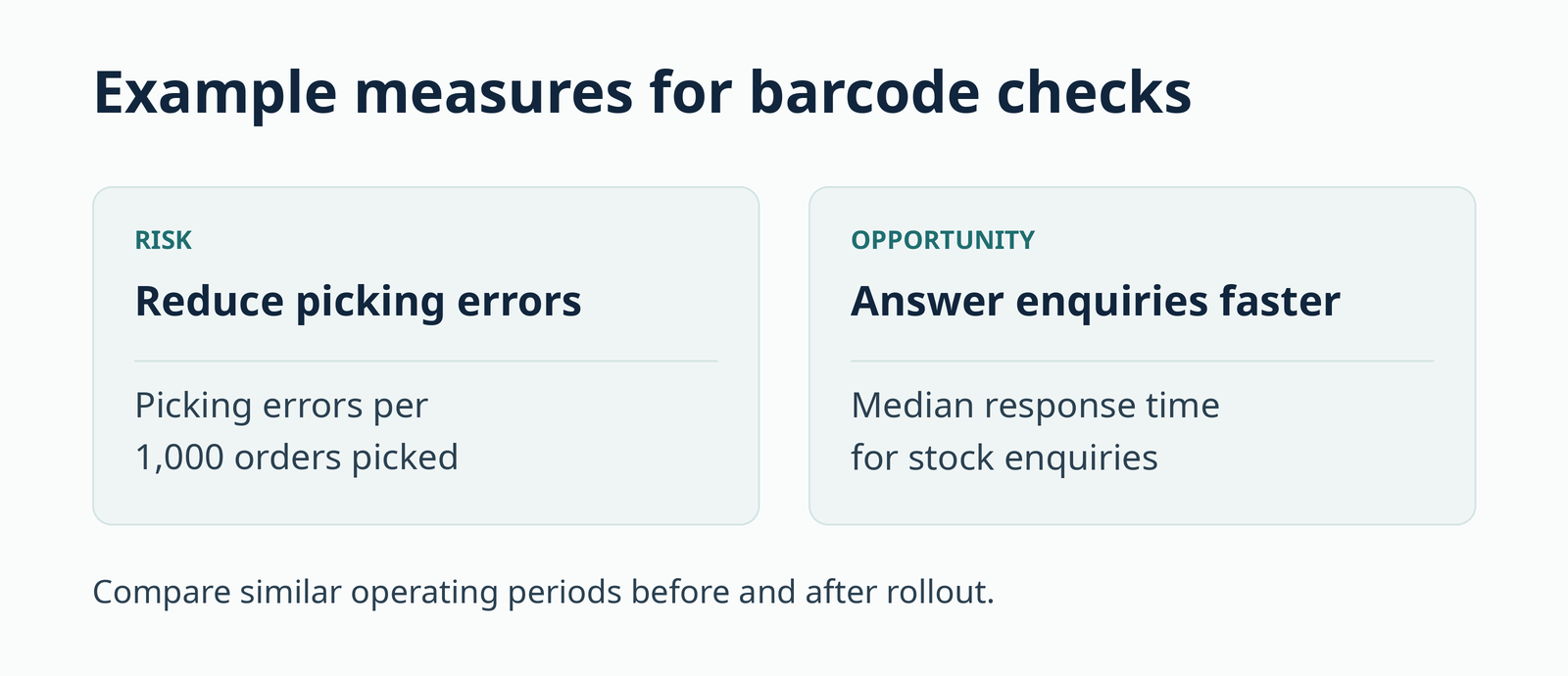
Adding barcode checks to reduce picking errors is an example of addressing a risk (6.1.2). Using the same scan data to respond to stock enquiries more quickly is an example of pursuing an opportunity (6.1.3).
Give each action an owner and track its results separately. This makes it easier to show whether the action achieved its intended outcome.
When planning changes to your QMS, explain how you will communicate the change, monitor its implementation, and review whether it worked (6.3).
If barcode checks are introduced, compare picking error rates and stock-enquiry response times before and after implementation. Retain the rollout notes, measurement results and review records as evidence.
Customer Feedback and Continual Improvement
Use surveys, complaints and relevant social-media comments to monitor customer satisfaction (9.1). ISO 9001:2026 broadens the sources of information organisations may use to understand customer perception.
Separately, evaluate whether actions taken to address risks and opportunities achieved their intended results (9.1). For example, review whether barcode checks reduced picking errors and whether the improvement was sustained.
For internal audits, define what each audit needs to find out, the requirements it will check, and the processes or areas it will cover. Share audit results with the managers responsible for taking action (9.2).
At management review, assess risks and opportunities separately. Also consider changes in the needs and expectations of customers and other interested parties (9.3).
If a customer shortens its delivery window, the management review results should show who will adjust dispatch arrangements and how the organisation will verify that deliveries meet the new requirement.
Use what you learn to improve processes, products and services, address future needs, and correct or prevent undesirable effects (10.1).
ISO 9001:2026 consolidates the former Clause 10.1 and Clause 10.3 requirements into a single Continual improvement clause. If a complaint shows that an agreed requirement was not met, treat it as a nonconformity where applicable and verify that corrective action was effective (10.2).
Booking the External Audit
Give your team time to operate the revised processes before the external audit.
If barcode checks have been introduced, prepare the rollout notes and picking-error data. This will help you explain what changed, why it changed, and whether the change delivered the intended result.
For first certification, Stage 1 assesses readiness, while Stage 2 evaluates whether the QMS is being implemented and is effective. Surveillance and recertification audits follow certification.
If you are already certified, ask your certification body whether the transition audit can be combined with a surveillance or recertification audit, or whether it needs to be scheduled separately. Allow time to address any findings and for the certification body to issue the updated certificate.
Preparing with QuESH Consultants
Tell us what you already have in place and when you would like to be ready.
We can help you identify which gaps to close first, determine what evidence to gather, and prepare confidently for your transition or certification audit.
Upcoming training sessions are being planned for you.
Sources
• ISO 9001:2026 publication and standard overview
• ISO overview of the changes in the 2026 edition
• ISO and IAF guidance on auditing the climate amendment
• Global ACI transition requirements for ISO 9001:2026
• DNV summary of changes in the published edition
• International Accreditation Service guidance on certification audits