ISO 9001:2026 was officially published on 16 September 2026, introducing the sixth edition of the world’s most widely used quality management standard.
For organizations already certified to ISO 9001:2015, the publication raises practical questions: What has changed? How significant are the changes? What should be reviewed first? And does an existing quality management system need to be rebuilt?
The message from ISO’s official launch is clear: ISO 9001:2026 is an evolution of the established Quality Management System (QMS) framework, not a complete reset.
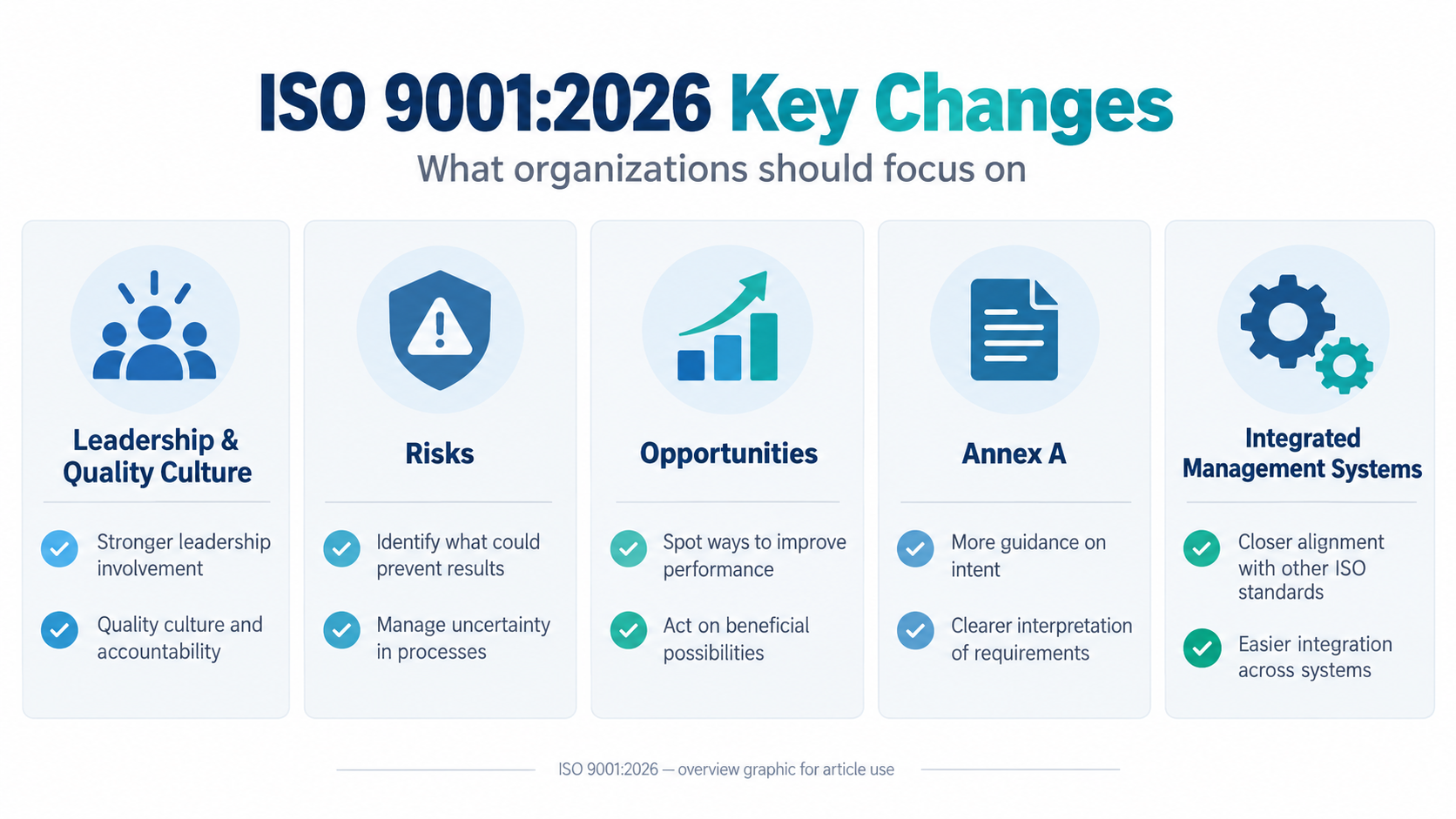
The revised edition uses clearer wording, places stronger emphasis on leadership and quality culture, provides greater clarity on risks and opportunities, introduces a new Annex A to clarify key terms and the intent of requirements, and aligns more closely with other ISO management system standards. These are among the principal changes highlighted by ISO in its official overview of the new edition. See ISO’s overview of what is new in ISO 9001:2026
Just as importantly, the launch positioned quality management as a business issue—not simply a certification exercise.
Quality, Trust and Business Performance
One of the strongest themes surrounding the launch was trust.
Sam Somerville’s launch-day perspective on trust and ISO 9001:2026 connects quality management with an organization’s ability to deliver on commitments, respond effectively when things go wrong, and behave consistently with its stated values.
That extends beyond customer satisfaction. Employees, suppliers, partners and other interested parties all depend on organizations turning commitments into consistent action.
A QMS therefore creates value when it supports clear responsibilities, consistent processes, accountable leadership, attention to risks and opportunities, learning and continual improvement.
That creates an important question for organizations preparing for ISO 9001:2026:
Does our management system mainly demonstrate compliance, or does it genuinely help us deliver reliable results?
Greater Attention to Leadership and Quality Culture
Leadership has always been important in ISO 9001, but the 2026 edition gives greater visibility to leadership, quality culture and accountability. ISO specifically identifies these as areas of stronger focus in the new edition.
Risks and Opportunities Become Clearer
Risk-based thinking remains an important part of ISO 9001:2026, but the revised edition provides a clearer distinction between risks and opportunities. ISO says this separation is intended to help organizations proactively pursue beneficial results as well as address uncertainty. Read ISO’s official description of the revised approach to risks and opportunities
Organizations are familiar with considering what could go wrong: supplier disruption, equipment failure, customer complaints, process errors, competence gaps or missed delivery targets.
Those risks still matter. But quality management should also help organizations identify beneficial possibilities.
An opportunity could involve automating an inefficient process, improving a customer interaction, developing supplier capability, strengthening employee competence or applying lessons from previous problems to improve future performance.
The clearer distinction encourages organizations to ask two different questions:
What could prevent us from achieving the intended result? And what could help us achieve a better one?
This makes planning more deliberate and prevents “opportunities” from becoming merely another item in the risk register.
Annex A Provides More Clarity
ISO 9001:2026 includes a new Annex A intended to clarify key terms and the intent behind requirements. ISO 9001:2026 — new Annex A and key changes
This is useful because management system requirements can sometimes be interpreted differently across organizations, industries and auditors.
The additional guidance should help organizations focus on what a requirement is intended to achieve rather than assuming every change requires a new procedure, form or document.
For transition planning, the first question should therefore be whether the existing process already meets the intent of the revised requirement.
Better Alignment With Other Management Systems
ISO 9001:2026 also aligns more closely with other ISO management system standards.
This is particularly relevant to organizations already operating standards such as ISO 14001, ISO 45001 or ISO/IEC 27001.
Common areas such as leadership, objectives, competence, audits, management review and continual improvement can be managed more consistently across systems.
For organizations with an integrated management system, the transition may therefore be an opportunity to simplify or align existing processes rather than add another layer of administration.
Why ISO 9001 Was Revised for 2026
The business environment has changed considerably since ISO 9001:2015 was published.
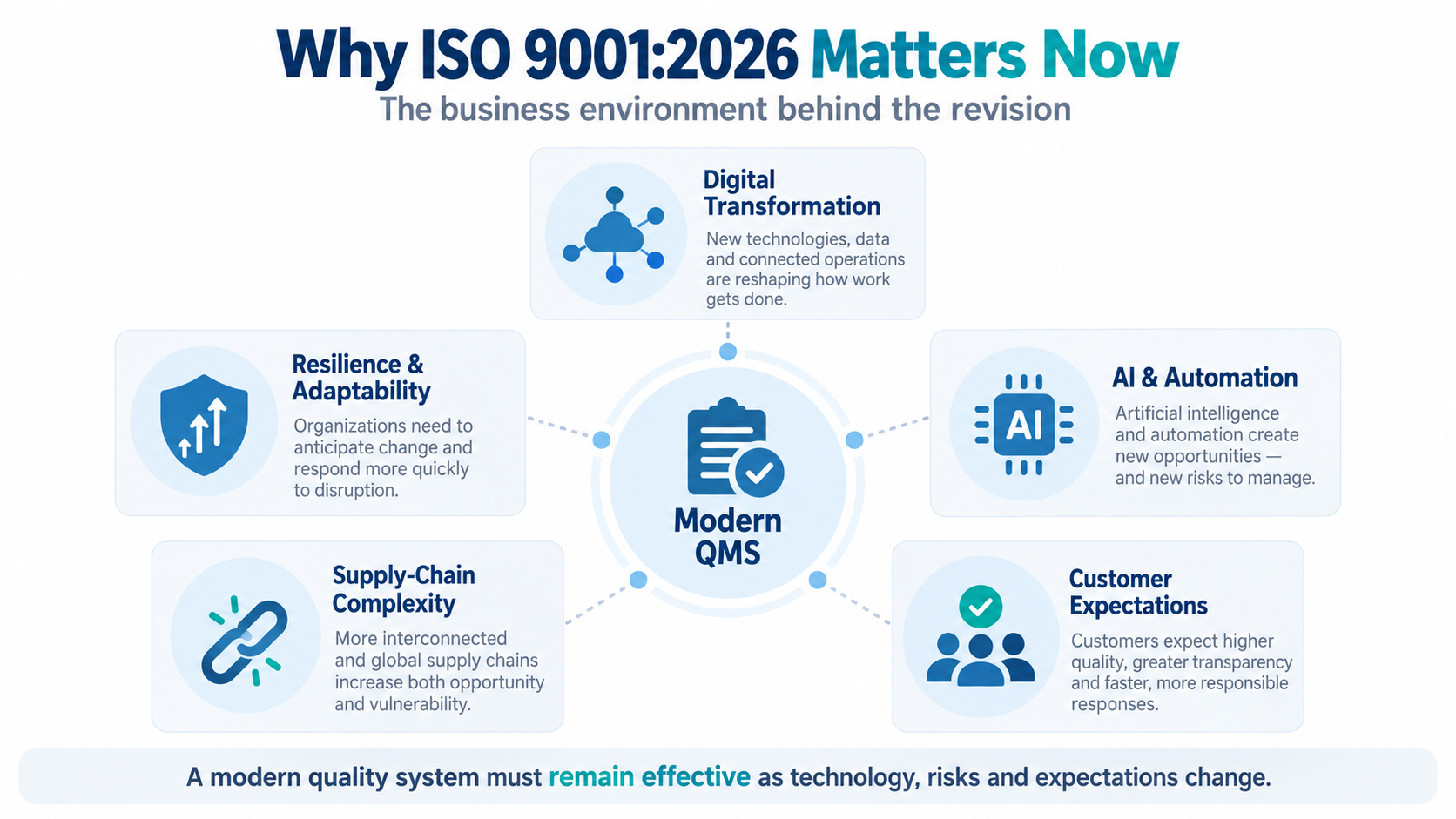
The official ISO 9001:2026 launch event placed the revision in the context of digital transformation, changing client expectations and increasing global supply-chain complexity. The event also highlighted the role of the standard in supporting resilience, innovation and long-term organizational performance.
The broader point is that a modern QMS must remain effective as technologies, processes, risks and customer expectations change.
The Practitioner Perspective: A QMS Must Work in Real Operations
The official launch also included Isabela Santos, Compliance Manager at Cundall, who was invited to share practical examples of how ISO 9001 benefits people and projects and how quality management can support organizational excellence.
That provides a useful test for any QMS.
Can employees understand their responsibilities? Do processes help teams work effectively? Can management obtain useful information? Are problems identified early and corrective actions addressing causes rather than symptoms?
When the answer is yes, ISO 9001 is functioning as a management system.
When the system exists mainly to prepare evidence for an annual audit, there may be a larger opportunity for improvement.
What Should Organizations Do Now?
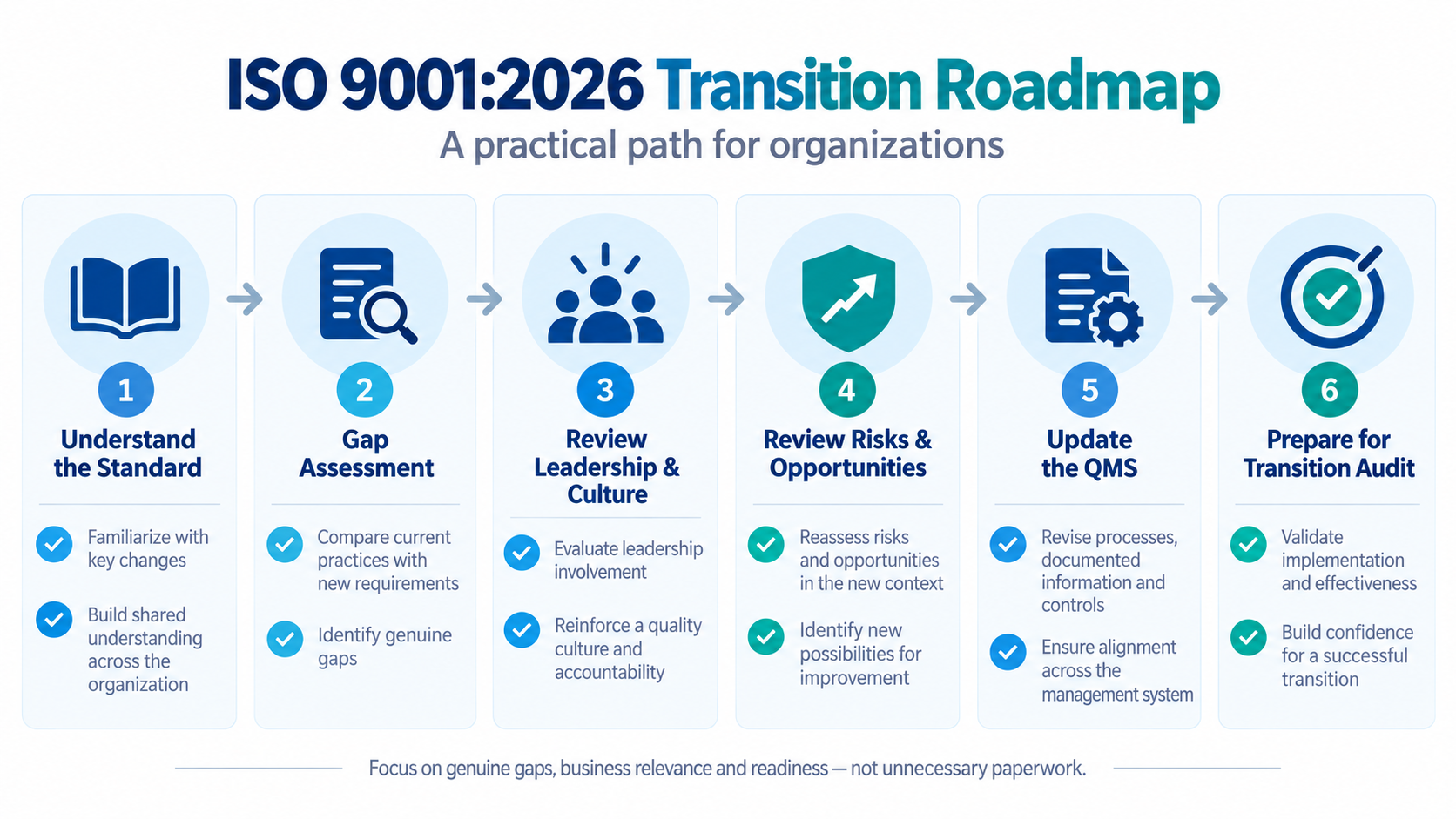
Organizations do not need to respond to publication by immediately rewriting their entire QMS.
A more practical approach is to compare the existing management system with the final ISO 9001:2026 requirements and identify:
• what already meets the revised requirements;
• where stronger evidence or clarification may be needed;
• where genuine gaps exist; and
• where existing processes could be simplified.
Leadership and process owners should be involved early. Transition should not become a project owned only by the quality department.
Organizations should also review risks and opportunities separately and avoid creating new procedures or forms unless they support a genuine requirement or business need.
The objective is not to produce more paperwork. It is to make sure the QMS continues to support reliable performance.