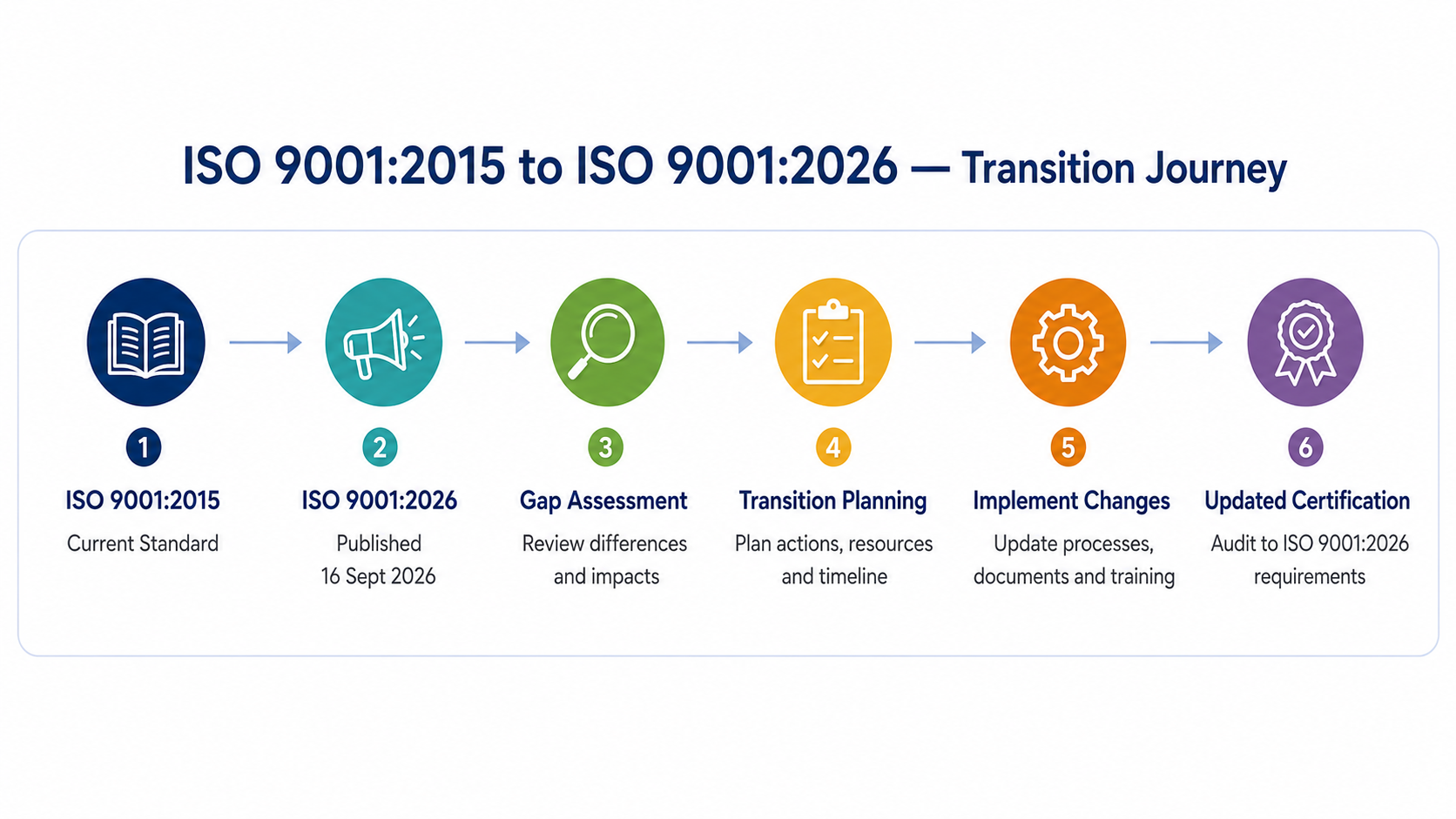
ISO 9001 is approaching its next revision. ISO has confirmed that the Final Draft International Standard (FDIS) was approved in August 2026, and the sixth edition is likely scheduled for publication on 16 September 2026.
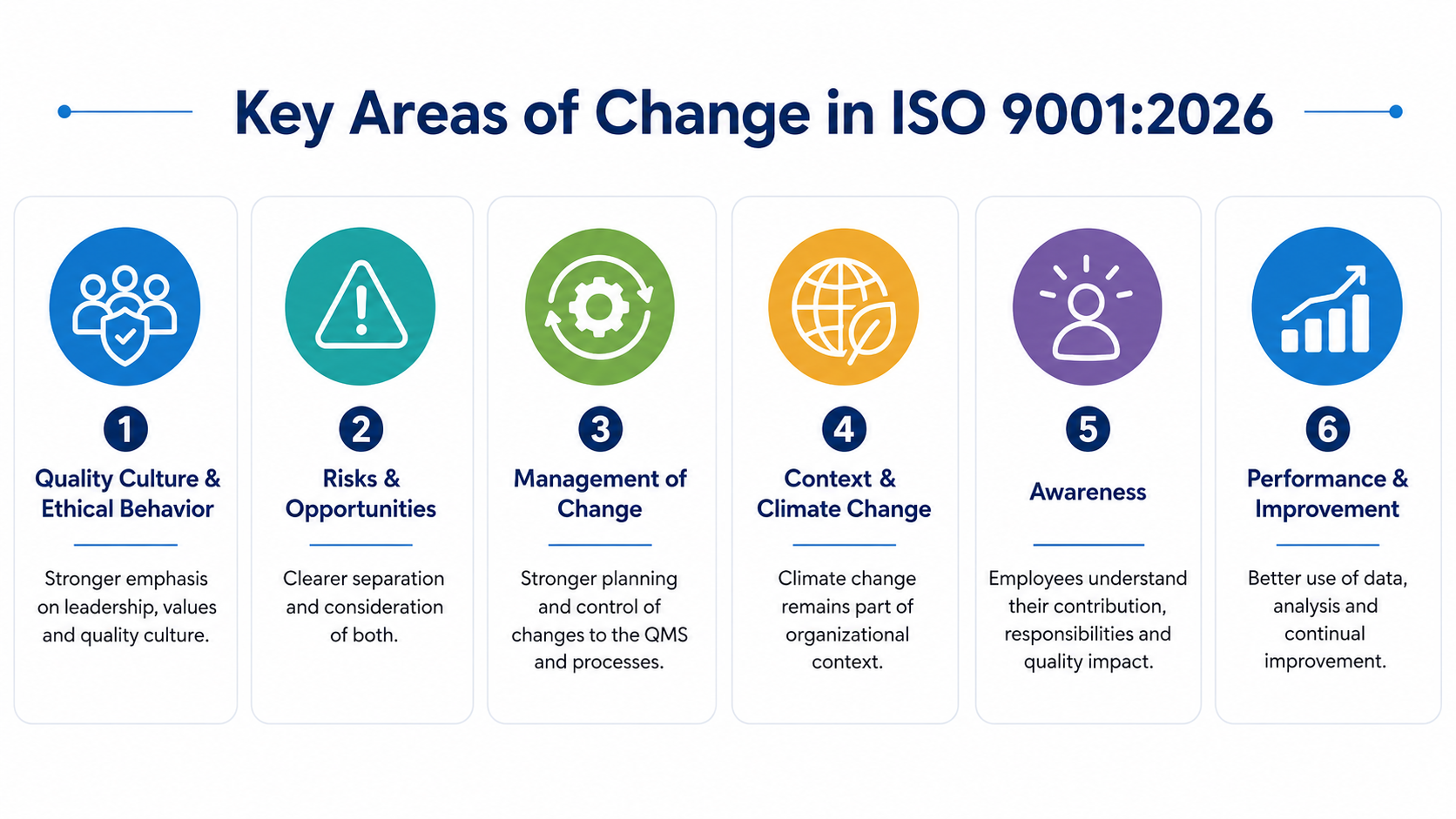
For organizations already certified to ISO 9001:2015, the transition is expected to be an evolution rather than a complete redesign of the quality management system (QMS). The familiar structure remains, while the revision strengthens or clarifies quality culture, ethical behavior, risks and opportunities, management of change, climate-related context, awareness, and continual improvement.
The purpose is not more paperwork. It is to connect quality management more closely with leadership, decision-making, changing business conditions, and consistent performance.
What Is the Expected Transition Timeline?
ISO/FDIS 9001 has been approved, and ISO has scheduled publication of ISO 9001:2026 for 16 September 2026.
After publication, certified organizations will be given a transition period to move from ISO 9001:2015. Organizations should wait for formal transition arrangements from ISO, accreditation bodies, and certification bodies before relying on a specific deadline.
Preparation can begin now. Management teams can review the major changes, brief process owners, and consider where the existing QMS may need adjustment. Formal document changes should be based on the published standard and confirmed transition requirements.
An Evolution, Not a Complete Rewrite
ISO 9001:2026 retains the established management-system framework and familiar principles, including customer focus, leadership, the process approach, evidence-based decision-making, risk-based thinking, performance evaluation, and continual improvement.
Many changes are clarifications or refinements rather than entirely new requirements. Organizations with a mature QMS should therefore strengthen existing practices instead of rebuilding the system.
Quality Culture and Ethical Behavior
One of the most notable developments is the stronger emphasis on quality culture and ethical behavior.
Leadership is expected to do more than approve a quality policy or attend management reviews. Top management should promote behaviors and values that support quality, customer confidence, responsible decision-making, and the integrity of the QMS.
This also affects employee awareness. Organizations should consider whether people understand how their work contributes to quality, can raise concerns, and see management respond appropriately to quality or ethical issues.
For many organizations, this may not require a new procedure. It may require clearer leadership expectations, better communication, stronger awareness activities, and evidence that quality-related behaviors are reinforced in practice.
Clearer Separation of Risks and Opportunities
Risk-based thinking remains central to ISO 9001, but the revision separates risks and opportunities more clearly.
Some organizations treated “risks and opportunities” mainly as a single risk register. The revised approach encourages consideration of both negative uncertainties and positive possibilities.
Risks may include supplier failure, competence gaps, technology disruption, changing customer requirements, or recurring defects. Opportunities may include automation, better use of data, stronger supplier relationships, improved customer experience, or more efficient workflows.
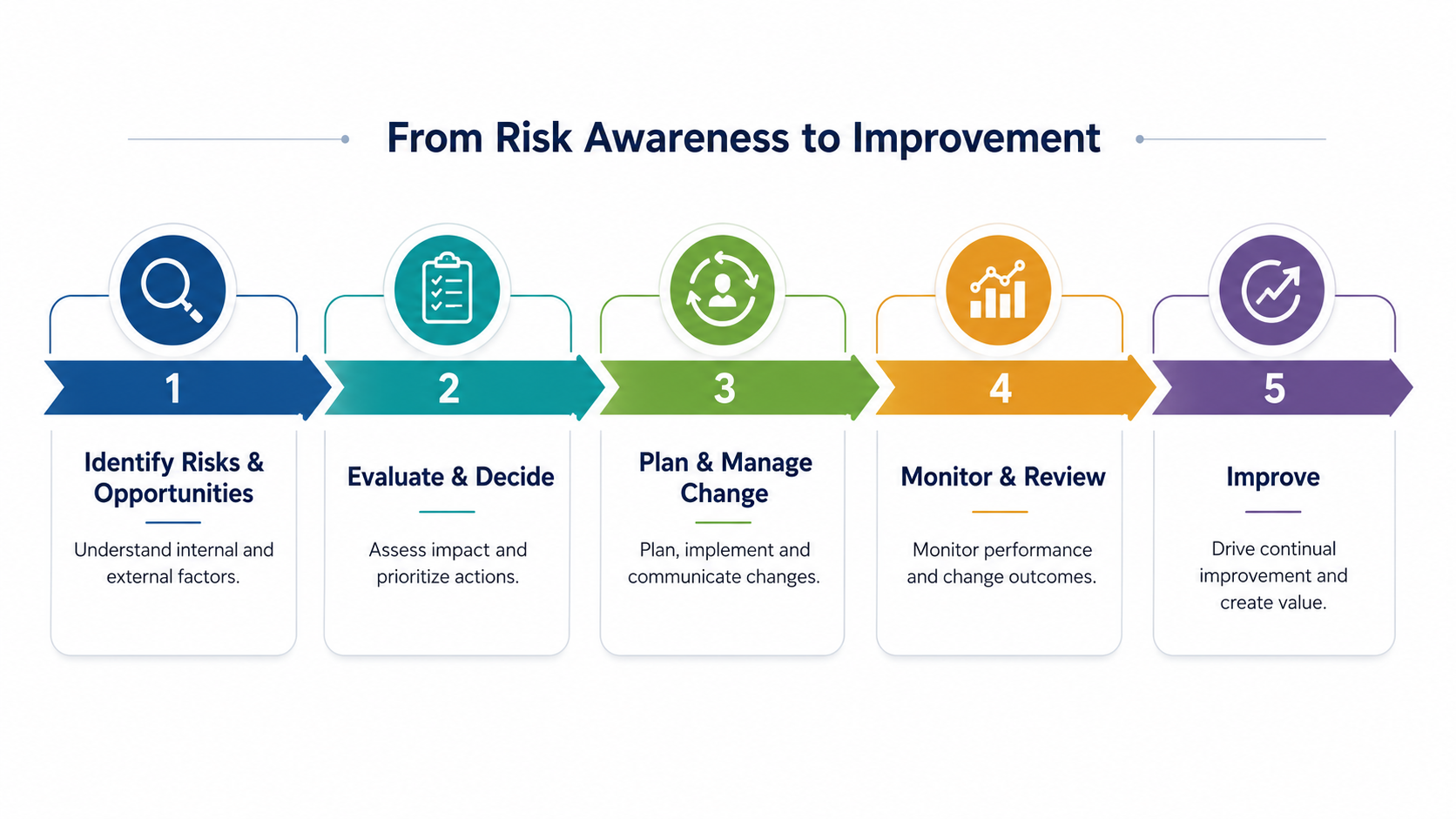
The aim is not a complicated register. Organizations should show that relevant risks and opportunities are identified, considered in planning, acted upon where necessary, and reviewed for effectiveness.
Stronger Management of Change
Management of change receives stronger attention in the revised standard.
Organizations regularly introduce new systems, equipment, suppliers, products, services, technology, and structures. Poorly managed changes can create defects, delays, complaints, or loss of process control.
ISO 9001:2026 reinforces structured planning of QMS changes so intended results are maintained. Organizations should consider the purpose of the change, potential consequences, resource needs, responsibilities, affected processes, communication requirements, and whether the change achieved its intended result.
A useful approach is to treat change as a cycle: plan, implement, monitor, evaluate, and improve.
Climate Change Remains Part of QMS Context
Climate change should not be presented as a completely new ISO 9001:2026 requirement.
ISO published ISO 9001:2015/Amd 1:2024 — Climate action changes in February 2024. The amendment applies directly to ISO 9001:2015 and requires climate change to be considered within the organization's context where relevant.
That climate-related wording is integrated into the upcoming revision.
For ISO 9001, this does not turn the QMS into an environmental management system. The organization must determine whether climate-related issues could affect its ability to provide conforming products and services or achieve intended QMS results.
Examples may include supplier or logistics disruption, changing customer requirements, infrastructure risks, resource availability, regulatory expectations, or operating conditions.
Context, Strategy and Interested Parties
The revision continues to strengthen the connection between organizational context, interested parties, strategic direction, risks, and quality objectives.
Context analysis should not exist only for an audit. Changes in markets, regulation, technology, supply chains, customer expectations, workforce capability, and other conditions should inform how the QMS is maintained.
Organizations should ask whether issues identified in their context review actually influence objectives, process controls, risk planning, management review, or improvement priorities.
Awareness Becomes More Important
Awareness requirements reflect the stronger focus on quality culture and ethical behavior.
Employees should understand the quality policy, relevant objectives, their contribution to QMS effectiveness, the consequences of nonconformity, and the behaviors expected in supporting quality.
Evidence does not need to come only from formal training. It may be shown through onboarding, team meetings, supervision, internal communication, problem reporting, improvement activities, and day-to-day leadership behavior.
Performance Evaluation: Use Existing Data Better
The core requirements for monitoring, measurement, internal audit, analysis, and management review remain largely familiar.
Organizations should use existing information more effectively rather than create additional metrics solely for certification. Useful indicators may include complaints, rework, delivery performance, supplier performance, audit findings, corrective-action recurrence, process capability, and customer satisfaction.
Management should use results to identify trends, recurring problems, deteriorating performance, and improvement opportunities. Performance evaluation should support decisions, not simply prove that measurement took place.
Continual Improvement and Annex A
Continual improvement remains fundamental. The revision consolidates and clarifies improvement requirements and reinforces leadership’s role in supporting improvement.
Improvement may result from changes in context, risks and opportunities, performance trends, customer feedback, corrective actions, or suitable technologies.
ISO 9001:2026 is expected to provide expanded informative guidance in Annex A to clarify terminology and the intent of selected requirements, helping organizations and auditors apply the standard more consistently.
Annex A is guidance, not an additional set of certification requirements.
What Should Organizations Do Now?
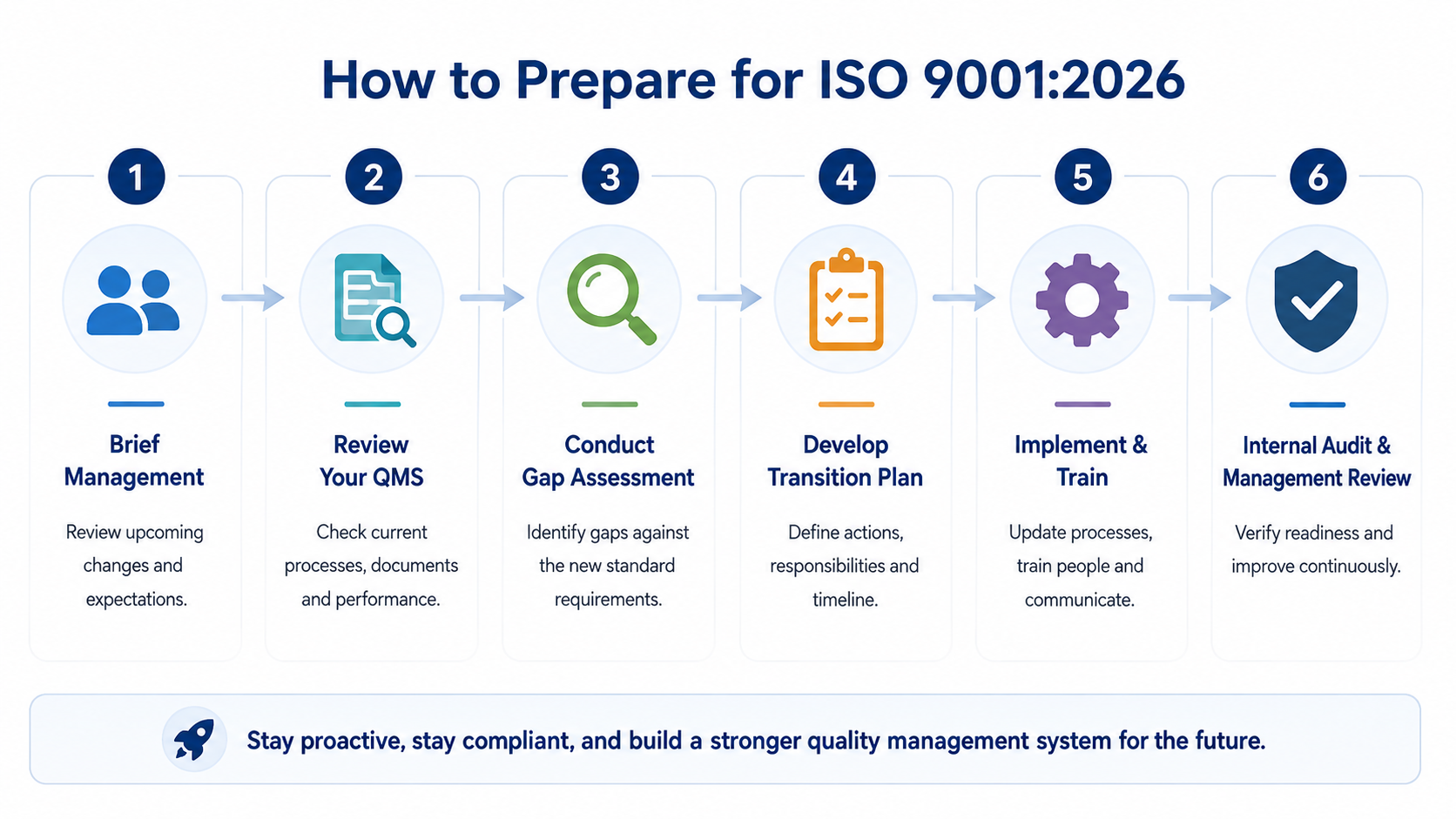
Organizations do not need to rewrite their QMS before the final standard is published. A practical approach is to prepare systematically.
Review how the current QMS demonstrates:
• Quality culture and ethical behavior
• Risks and opportunities
• Management of change
• Climate-change relevance
• Employee awareness
• Performance analysis
• Continual improvement
Brief top management and process owners. Identify where current practices already meet the revised intent and where stronger evidence or clearer processes may be needed.
After publication, conduct a formal gap assessment against ISO 9001:2026 and turn the findings into a transition plan aligned with normal audit, training, management review, and improvement activities.
Are You Ready for ISO 9001:2026?
ISO 9001:2026 is not expected to overturn established quality management systems. Its direction is to make them clearer, more relevant, and more closely connected with leadership behavior, quality culture, risks and opportunities, controlled change, and continual improvement.
Organizations that prepare early can understand the changes without rushing into unnecessary document revisions.
QuESH Consultants can support organizations with ISO 9001:2026 gap assessment, transition planning, documentation review, internal audit preparation, training, and implementation support.
Contact QuESH Consultants to start preparing for ISO 9001:2026.